Shotcrete (Wet Mix)

Shotcrete (Wet Mix)

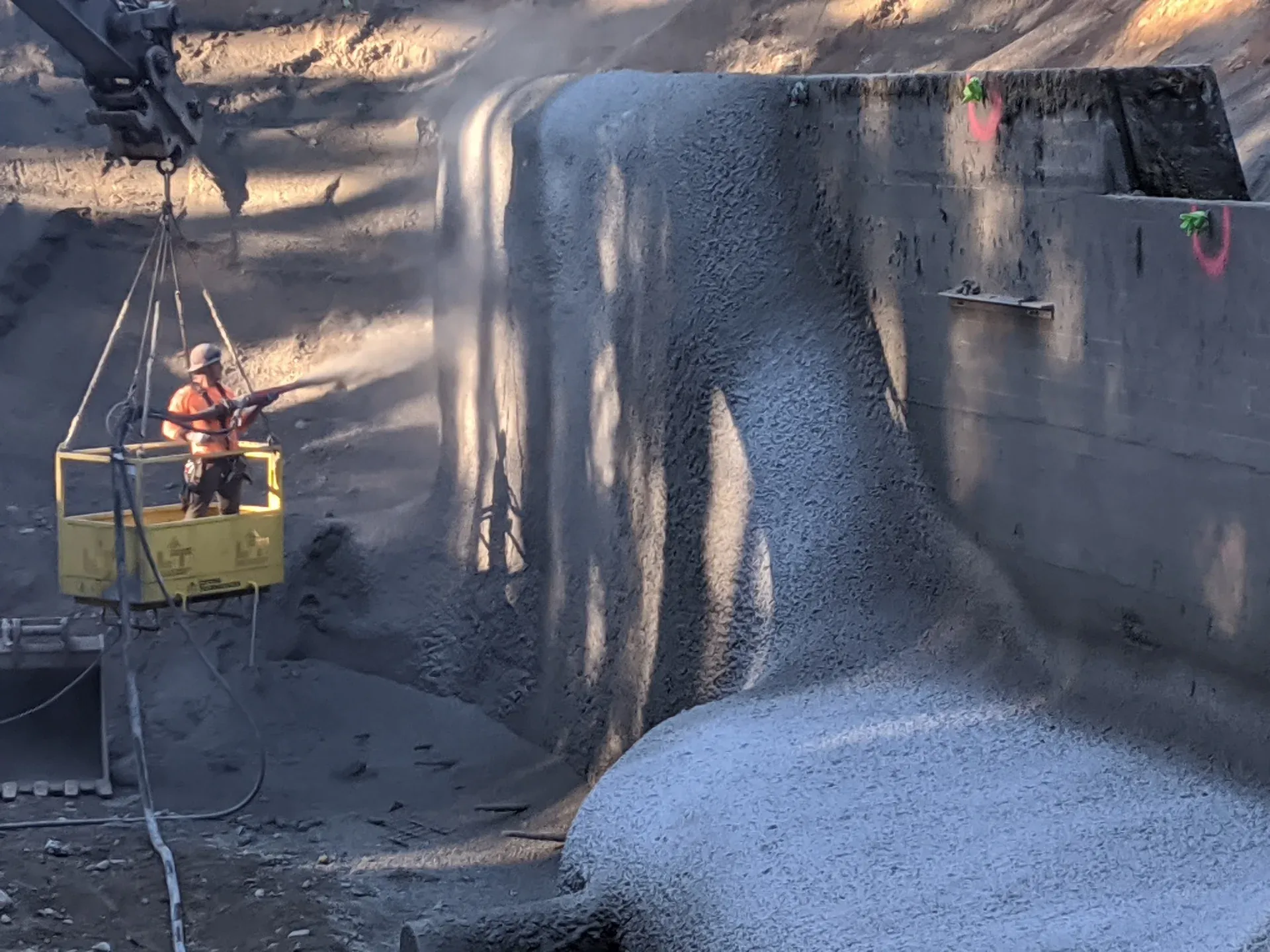
Wet-mix shotcrete is the production-rate placement process where concrete is pre-batched with water, pumped through a delivery hose, and propelled onto the work surface by compressed air at the nozzle. Plant-batched water-cement ratio gives consistent strength and the lowest rebound in the shotcrete family, making wet-mix the default process for permanent civil structural work.

30+
CY/Hour
8000+
PSI Strength
10-20%
Vertical Rebound
ACI 506.2
Specification
Overview

Understanding Wet-Mix Shotcrete

Wet-mix shotcrete is the production-rate placement process for structural shotcrete. Concrete is pre-batched at the plant or on-site mixer with full water content, pumped through a delivery hose to the nozzle, and propelled onto the work surface by compressed air introduced at the gun. Plant-batched water-cement ratio gives consistent strength, production rates of 15 to 30 plus cubic yards per hour, and rebound on the order of 10 to 20 percent on vertical work, the lowest in the shotcrete family.

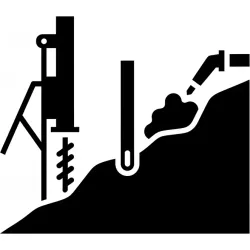
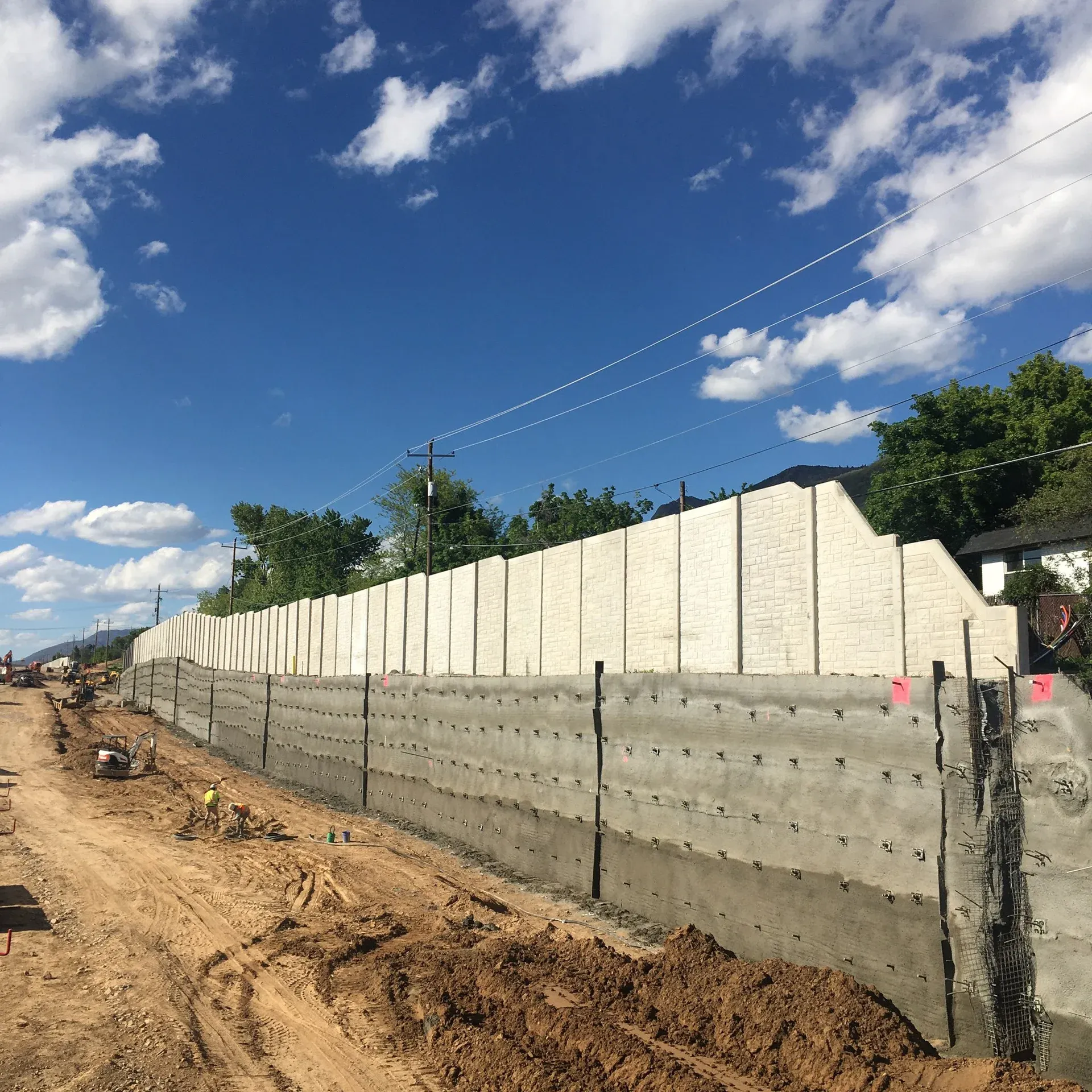
The process is the default for permanent civil structural work where volume, consistency, and verifiable strength matter most: soil nail wall facings, tunnel primary and final linings, retaining walls, dam and spillway rehabilitation, and channel and culvert linings. Dry-mix shotcrete serves remote, intermittent, repair, and overhead-dominant work where ready-mix and pump logistics are not practical. Our ACI CP-60 certified nozzlemen produce wet-mix work under ACI 506 family specifications with documented test panels and core sampling per ACI 506.2 and ASTM C1604.

What Is Wet-Mix Shotcrete?

Wet-mix shotcrete is the placement process where concrete arrives at the nozzle pre-batched with full water content. Material is mixed at the batch plant or by an on-site continuous mixer, conveyed by hose to a piston or progressive-cavity pump, propelled through the delivery line, and placed by compressed air introduced at the nozzle. ACI 506R defines this as the wet-mix process, distinguishing it from dry-mix shotcrete where water is metered in by the nozzleman at the moment of placement.

The defining characteristic is plant-batched water-cement ratio. Because water is metered into the mix once at batching, the strength, slump, and air content of the placed material match the design mix throughout the day, eliminating the operator-dependent water variability that characterizes dry-mix. Permanent civil structural shotcrete work, including soil nail wall facings, retaining walls, and tunnel linings, overwhelmingly uses wet-mix for this consistency. The dry-mix process was first trademarked as gunite in 1907, and wet-mix entered widespread civil practice decades later as concrete pumping technology matured. Modern alkali-free accelerator dosing and high-pressure piston pumps have since made wet-mix the volume process for civil structural shotcrete.

Key Benefits

  • Plant-batched water-cement ratio for consistent strength
  • Production rate of 15 to 30 plus cubic yards per hour
  • Lower rebound than dry-mix (10 to 20 percent on vertical work)
  • Substantially lower dust generation than dry-mix
  • Compatible with alkali-free liquid accelerator dosing

Used In Our Services

The Engineering

How Wet-Mix Shotcrete Is Placed

How the system carries load in service, and how we build it on site.

Material delivery begins at the batch plant or an on-site continuous mixer. Plant-batched ready-mix concrete is delivered by truck to the pump hopper, with a typical small-aggregate mix (3/8 inch top size) proportioned for pumpability and placement. Where ready-mix delivery is not practical, an on-site continuous mixer (auger or pug mill type) batches material from bagged or silo-stored cement and aggregate as the work progresses. Mix designs are governed by ACI 506R guidance, with verified compressive strength typically 4,000 to 8,000 psi and the project specification calling out slump, air content, and aggregate gradation.

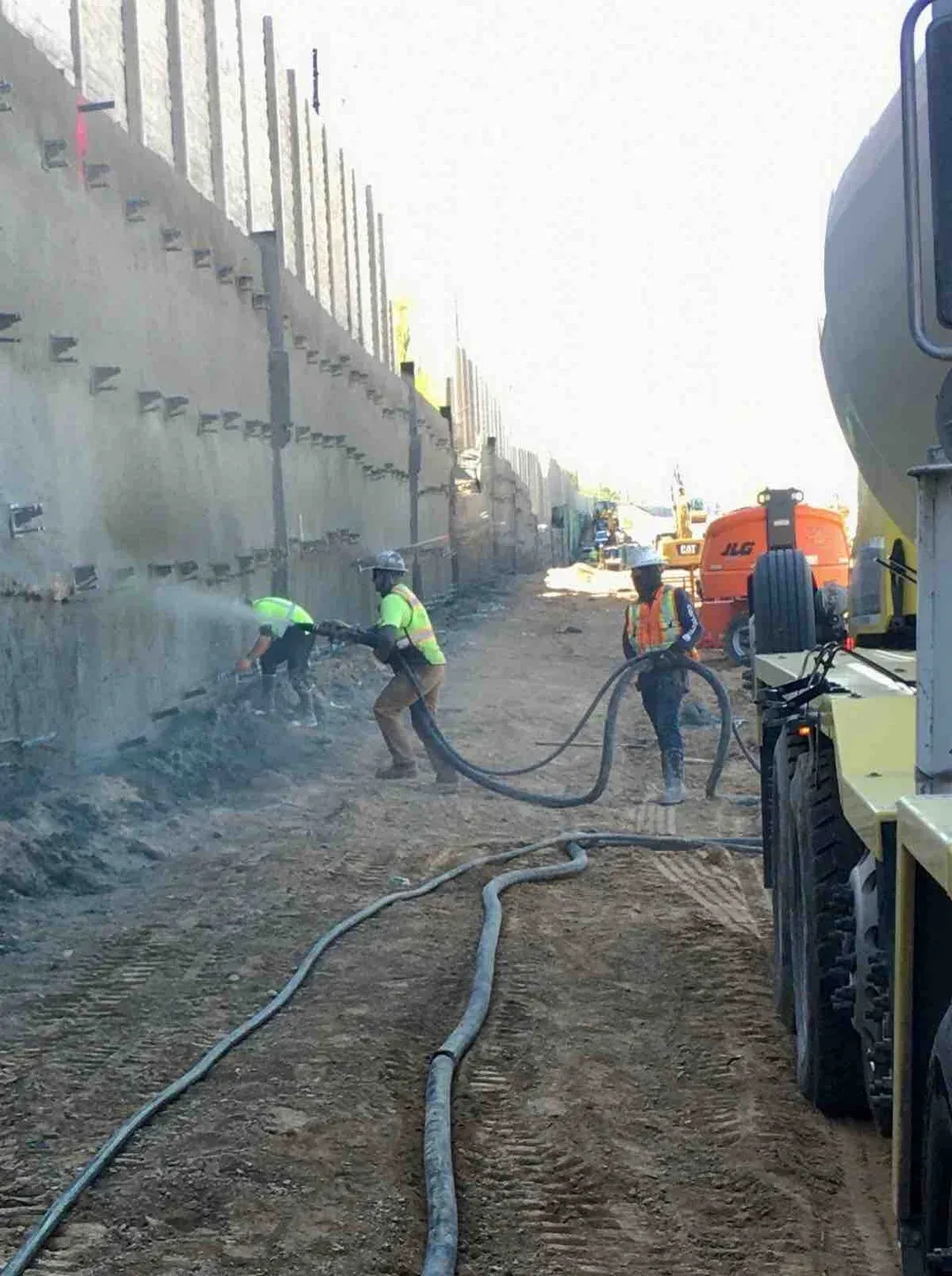
Pumping is the heart of the wet-mix process. Piston pumps deliver high-volume placement (15 to 30 plus cubic yards per hour) for large-scale work, while progressive-cavity (rotor-stator) pumps serve smaller crews and longer hose runs. Delivery hose runs of several hundred feet horizontal and tens of feet vertical lift are routine, allowing wet-mix application well beyond truck access. At the nozzle, compressed air is introduced at the manifold, providing the placement velocity (typically 60 to 100 mph at the nozzle exit) that consolidates the material against the substrate and behind every reinforcing bar. Accelerator, when used, is metered into the material stream at the same point.

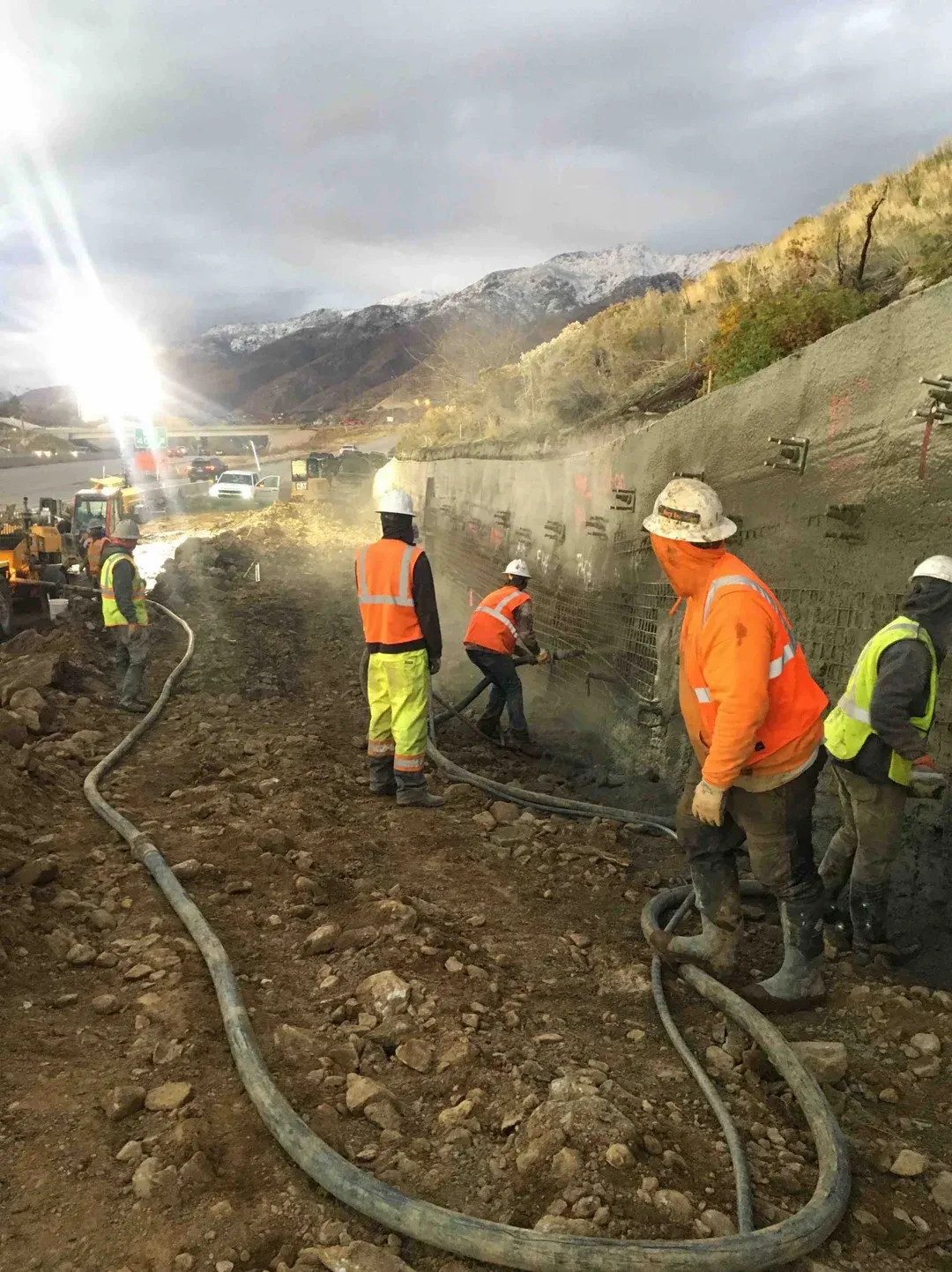
Placement discipline mirrors all structural shotcrete work. The nozzleman holds the gun approximately perpendicular to the face at a 3 to 6 foot standoff, applying material in lifts of 2 to 4 inches per pass. Reinforcement is encapsulated by gunning behind every bar from both sides before closing the face, the dominant control on shadow voids that compromise structural integrity. Successive lifts are placed after the prior lift has stiffened, typically 30 to 60 minutes for unaccelerated wet-mix in moderate temperatures. Quality control follows ACI 506.2: production test panels (typically 18 by 18 by 4 inches) are shot alongside the work, cured under matched site conditions, and cored at 7 and 28 days for compressive strength testing per ASTM C1604, with in-place cores from the production work verifying thickness, reinforcement cover, and consolidation.

1

Plant Batching and Delivery

Concrete batched with full water content per ACI 506R proportioning. Ready-mix delivery or on-site continuous mixer feeds the pump hopper.

2

Surface Preparation

Substrate scaled clean and dampened. Edge forms or ground wires set to define face line and total thickness.

3

Reinforcement Placement

Rebar grid, welded wire mesh, or fibers per project structural design. Cover maintained with chairs and spacers.

4

Pumping and Placement

Piston pump conveys mix through hose to nozzle. Compressed air at the nozzle ring (80 to 150 psi) provides placement velocity. Lifts of 2 to 4 inches per pass; encapsulation behind every bar.

5

Quality Control

Production test panels and in-place cores per ASTM C1604 verify strength, thickness, and reinforcement cover under ACI 506.2 acceptance.
System Variants

Wet-Mix Production Variants

Type 01

Standard Pumped Wet-Mix

Plant-batched ready-mix concrete delivered by truck and pumped through a piston or progressive-cavity shotcrete pump is the production default for civil structural work. Production rates of 15 to 30 plus cubic yards per hour, plant-batched water-cement ratio, and rebound on the order of 10 to 20 percent on vertical work make this the workhorse configuration for soil nail wall facings, retaining walls, channel armoring, and bridge abutment facings. Mix designs typically carry 3/8 inch top-size aggregate for pumpability, 4,000 to 6,000 psi 28-day compressive strength, and welded wire mesh or rebar grid reinforcement per project structural design. The configuration depends on truck-accessible jobsites and an active ready-mix supplier, the limiting constraints in remote work.

Type 02

Continuous-Feed Wet-Mix (On-Site Mixer)

An on-site continuous mixer (auger or pug mill type) batches concrete from bagged or silo-stored cement and aggregate as the work progresses, eliminating the ready-mix supply chain dependency that constrains the standard pumped configuration. Production rates are lower (8 to 15 cubic yards per hour typical) than truck-fed pumping, but the configuration extends wet-mix placement to remote sites and to extended-duration work where ready-mix delivery windows or batch-life constraints make truck delivery unworkable. Mix proportions are controlled at the mixer rather than at the plant, with QC verified by the same ACI 506.2 test-panel and coring protocol used for plant-batched work. The configuration is common on long-duration tunnel work, on remote slope-stabilization projects, and on jobs in regions where the nearest ready-mix plant is too far for reliable supply.

Type 03

Accelerator-Dosed Wet-Mix

Set accelerator (typically alkali-free aluminum sulfate or sodium silicate) is metered into the material stream at the nozzle, reducing initial set time from 2 to 4 hours to 5 to 15 minutes. The configuration is required for tunnel-crown placement under New Austrian Tunneling Method practice, for water-infiltration zones with running water at the face, for thick-section build-ups in a single pass, and for emergency primary support after blast-and-muck cycles. NATM tunnel primary linings depend on accelerator-dosed wet-mix to develop early strength under closed-ring loading immediately after excavation. Modern alkali-free accelerators (used in place of older sodium-silicate or alkaline products) reduce strength loss in the cured material and improve worker safety, and are the standard for permanent linings. Accelerator dosage typically 4 to 8 percent by weight of cement, calibrated through site mockups and verified by ACI 506.2 panel testing.

Side By Side

Wet-Mix vs Alternative Placement Configurations

VS

Wet-Mix vs Dry-Mix Placement

The defining difference is when water enters the mix. Wet-mix is pre-batched at the plant or on-site mixer with full water content and pumped to the nozzle, where compressed air provides only placement velocity. Plant-batched water-cement ratio gives consistent strength, higher production (15 to 30 plus cubic yards per hour), and lower rebound (10 to 20 percent on vertical work, 20 to 30 percent overhead). Dry-mix shotcrete conveys dry materials by air to the nozzle, where the nozzleman meters water in at placement, giving real-time water control suited to overhead and intermittent work, but at higher rebound (20 to 40 percent on vertical, 30 to 50 percent overhead) and substantially more dust generation. Wet-mix dominates permanent civil structural work; dry-mix dominates remote, intermittent, repair, and overhead-dominant placement.

VS

Wet-Mix Shotcrete vs Cast-in-Place Pumped Concrete

Both processes use pumped concrete, but the placement mechanism differs. Wet-mix shotcrete is consolidated by placement velocity (compressed air at the nozzle propels material at 60 to 100 mph against the substrate) and is placed without a back form, with shotcrete conforming directly to rock, soil, or existing concrete. Cast-in-place pumped concrete requires both inside and outside forms, is consolidated by mechanical vibration after placement, and accepts larger maximum aggregate (3/4 to 1.5 inch typical, versus 3/8 inch for shotcrete). Cast-in-place is the right tool when geometry is regular and forming is straightforward; shotcrete wins when the back face is rock or soil, when the geometry is curved or irregular, or when access to set both forms is restricted. Both achieve equivalent compressive strength when properly designed, with shotcrete routinely specified at 4,000 to 8,000 psi to match standard structural concrete.

VS

Plant-Batched vs On-Site Continuous-Mixer Wet-Mix

Plant-batched ready-mix delivered by truck gives the highest production rate, the tightest QA chain, and the lowest unit cost on jobs with reliable truck access and an active ready-mix supplier within practical haul distance. On-site continuous mixers extend wet-mix to remote sites, to long-duration work where ready-mix batch-life constraints (typically 90 minutes from batching to placement) become limiting, and to jobs where ready-mix plant capacity is the bottleneck. Mix designs are functionally equivalent at the wall: ACI 506R proportioning applies to both, ACI 506.2 acceptance testing applies to both, and ASTM C1604 cores verify in-place strength for both. The selection is logistics, not material performance. A single project may use both configurations as conditions change across the site or schedule.

Not sure which system fits? We'll walk through the tradeoffs for your site conditions.

Talk Through Your Options
Where It Fits

Where Wet-Mix Shotcrete Is Used

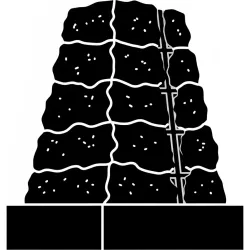
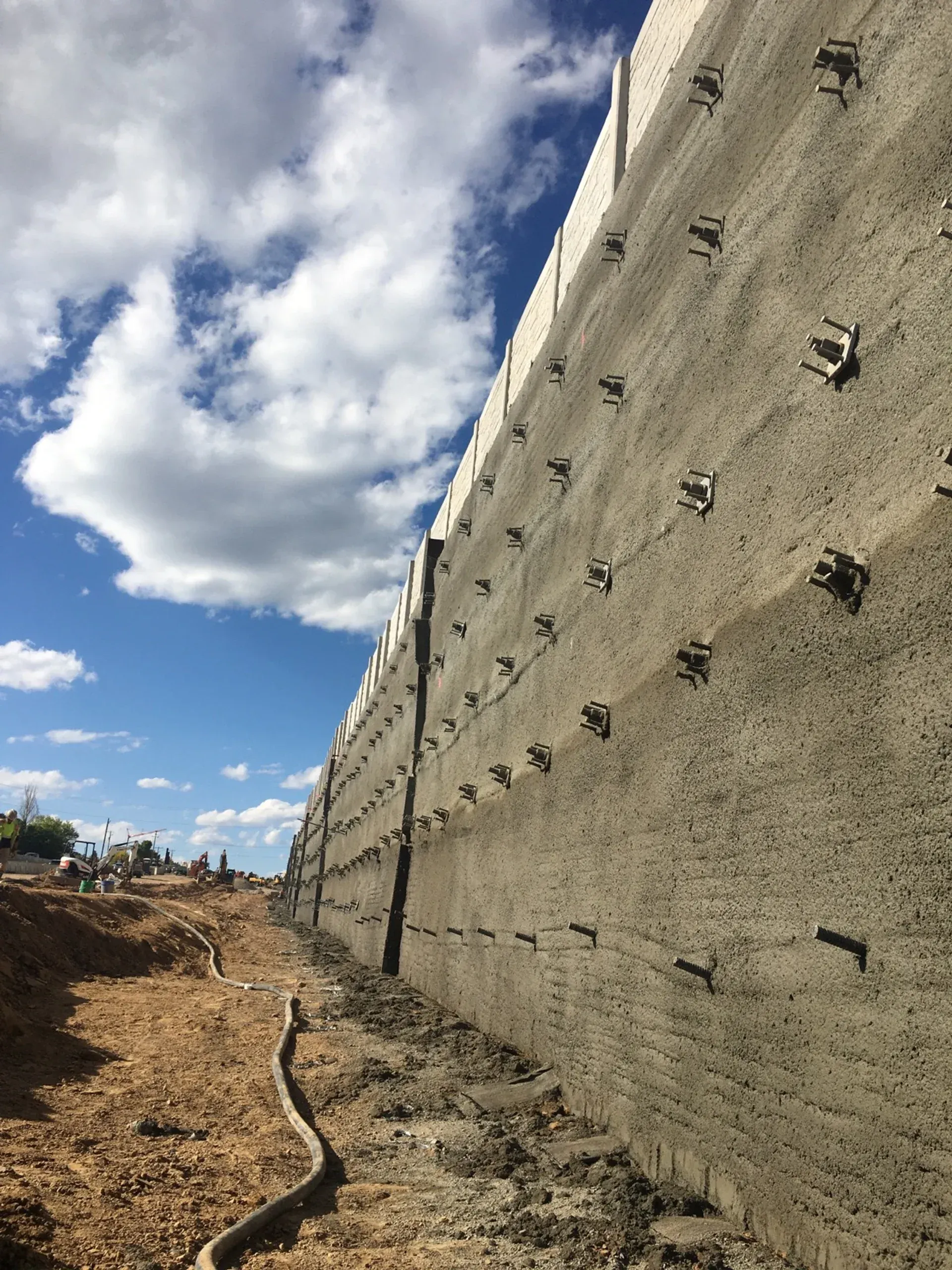
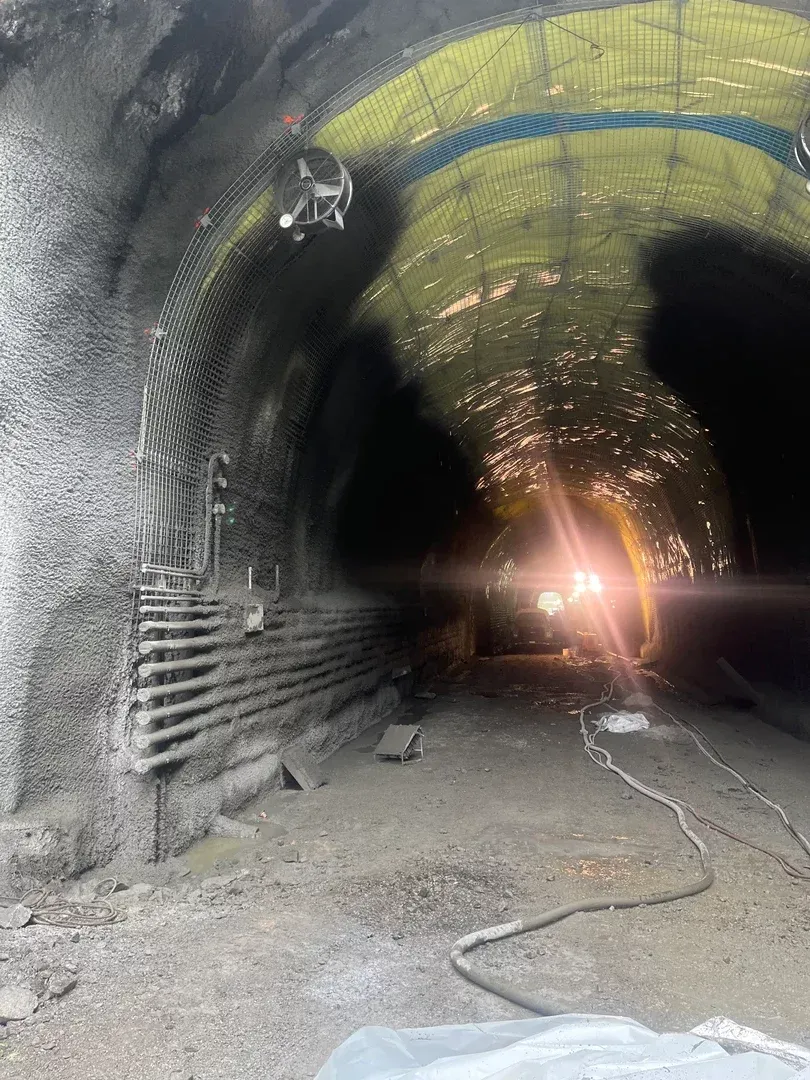
Soil nail wall facing is the dominant wet-mix application by volume in civil work. Soil nail reinforcement transfers earth pressure to the facing through bearing plates at each nail head, and wet-mix shotcrete distributes that load between nails as a continuous reinforced facing, typically 6 to 10 inches thick with welded wire mesh and waler bars. FHWA NHI-14-007 governs the design of this composite system for permanent walls. Tunnel primary and final linings are the second major application: accelerator-dosed wet-mix forms the immediate ground-support shell after excavation under New Austrian Tunneling Method practice, with FHWA NHI-10-034 sections 6 and 10 covering shotcrete tunnel-lining design for road tunnels. Permanent retaining walls, dam and spillway rehabilitation, channel and culvert linings, and bridge abutment facings round out the high-volume civil applications.

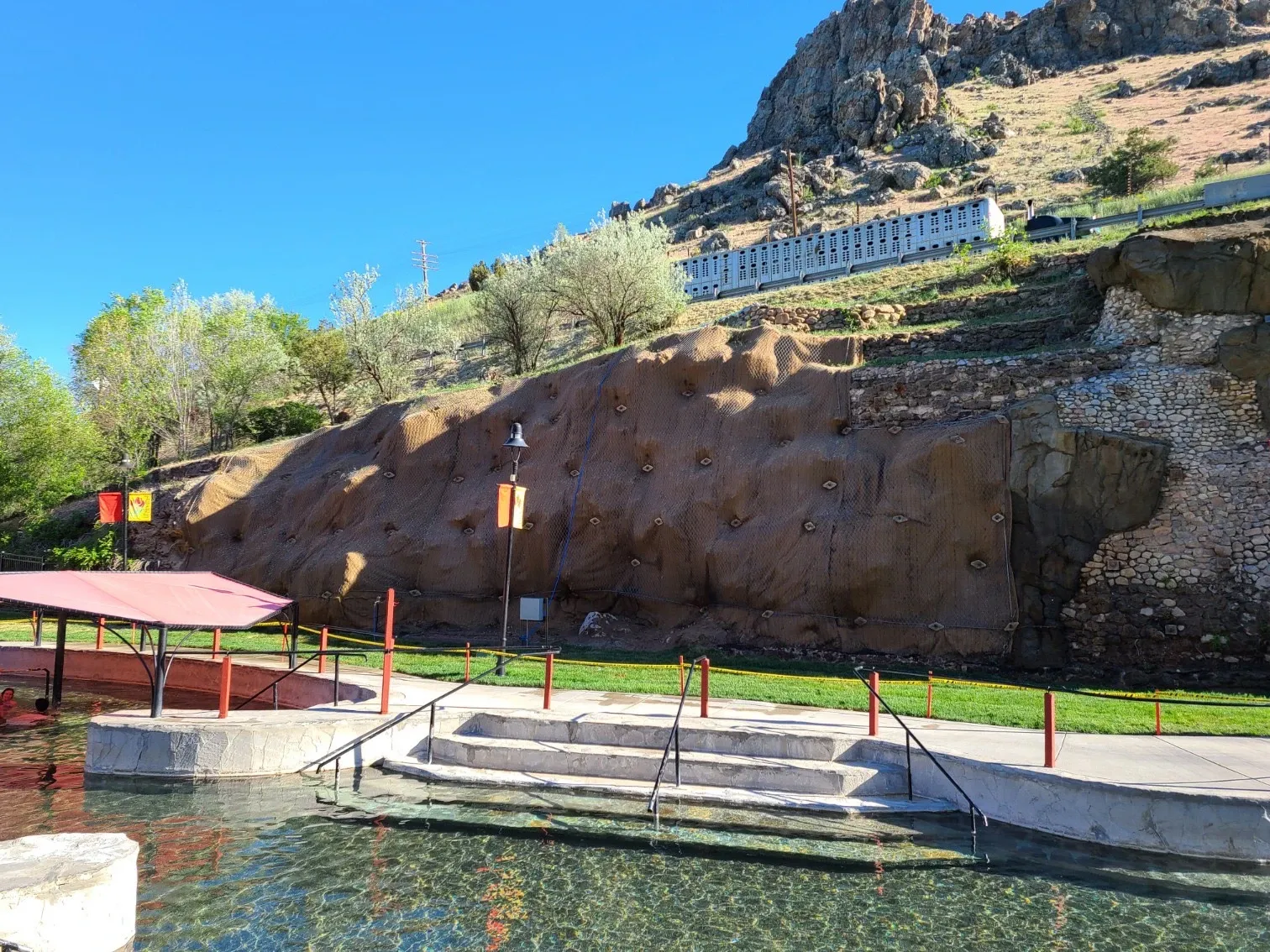
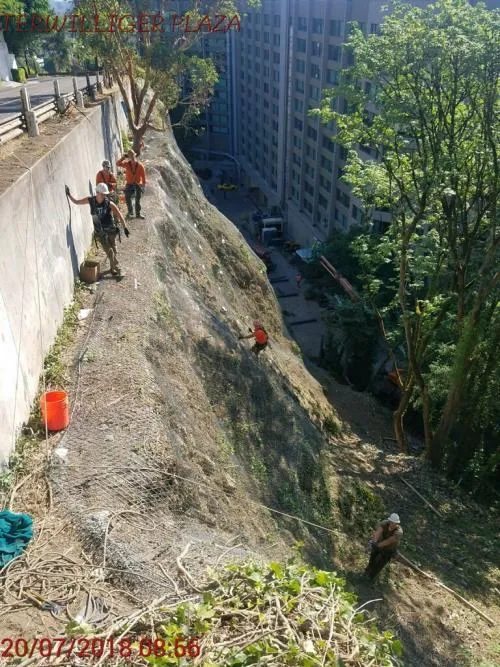
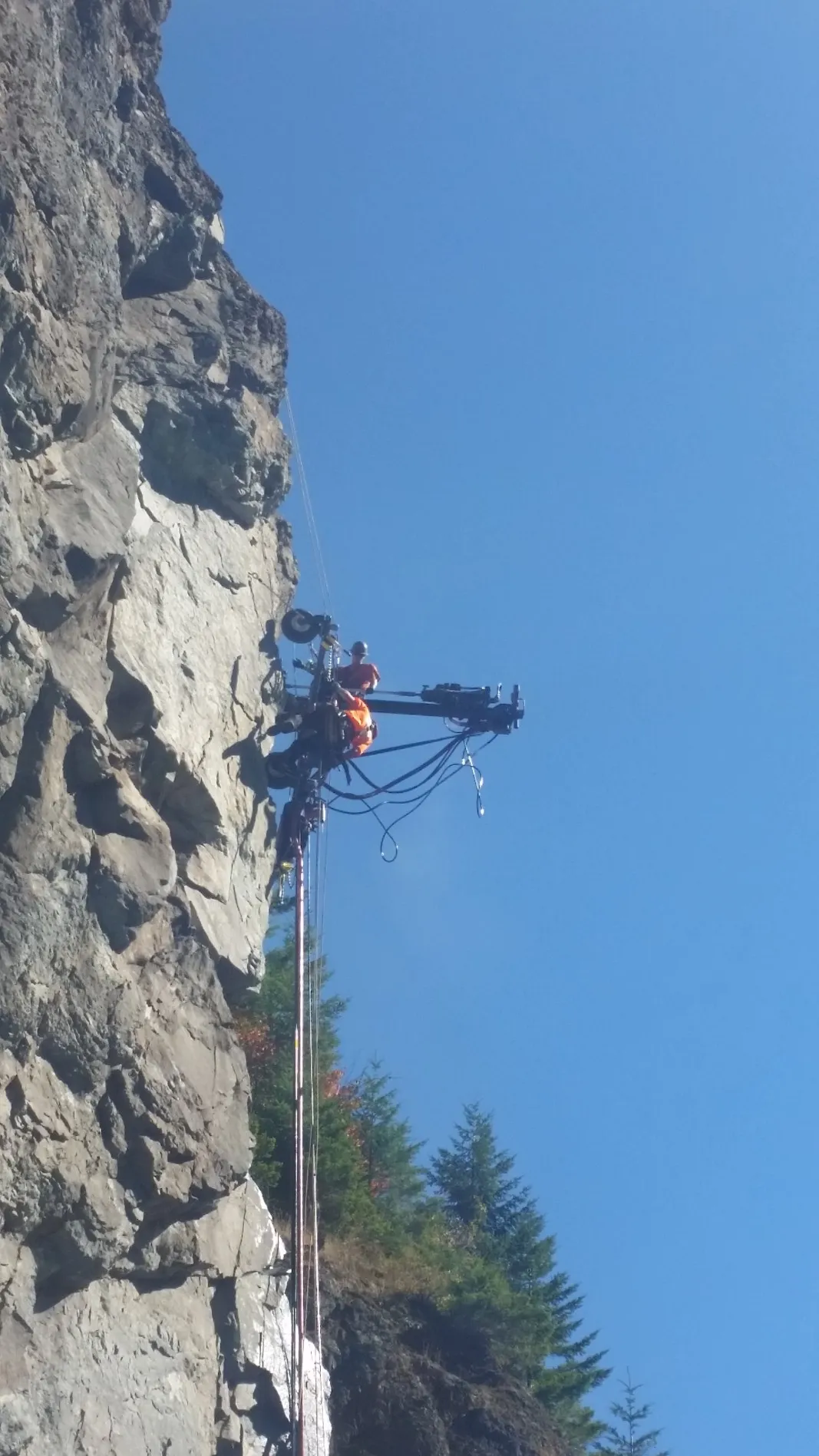
Beyond the headline applications, wet-mix is the production process behind soldier-pile lagging in shotcrete (where the material spans between flanges of H-pile soldier piles as engineered structural lagging), MSE wall face-up details where shotcrete forms the architectural face, and composite rock support paired with rock bolts on rock-cut faces. The pump-and-hose configuration also extends wet-mix into difficult-access work that would defeat ready-mix delivery: vertical slope faces accessed by rope or basket, retaining walls behind buildings where truck approach is blocked, and tunnel-portal segments inboard of the truck-turnaround point. Shotcrete contractors with ACI CP-60 certified nozzlemen produce the work under ACI 506 family specifications, with mix design, reinforcement, and acceptance testing tailored to each application.

Soil nail wall facing
Tunnel primary and final lining
Permanent retaining walls
Dam and spillway rehabilitation
Channel and culvert armoring
Soldier-pile shotcrete lagging
Benefits

Key Advantages

Production Capacity

Positive-displacement piston pumps deliver 15 to 30 plus cubic yards per hour, against 3 to 8 for dry-mix, making wet-mix the right tool for production civil structural work.

Plant-Batched Consistency

Water enters at the plant, not at the nozzle. The water-cement ratio is bounded by the batch ticket, not by the nozzleman's judgment, giving predictable compressive strength and reinforcement bond.

Lower Rebound

Wet-mix rebound is 10 to 20 percent on vertical work and 20 to 30 percent overhead, against 20 to 40 percent and 30 to 50 percent for dry-mix in the same orientations.

Lower Dust

Plastic concrete generates substantially less airborne dust than dry-mix, improving working conditions and reducing containment, ventilation, and respiratory protection requirements.

Accelerator Compatibility

Alkali-free liquid accelerators metered at the nozzle enable thicker single lifts, overhead placement, and placement against active water on tunnel primary linings under NATM practice.

Engineering

Technical Considerations

Soil/Rock Conditions

Substrate scaled clean of loose material and dampened before placement. Bond testing required on rehabilitation work where existing surface condition is variable.

Groundwater

Active inflow controlled with weep drains, diversion, or alkali-free accelerator dosing at the nozzle. Hydrostatic pressure on permanent walls relieved through facing weep drains.

Load Capacity

Structural capacity per ACI 506R proportioning and project structural design. Acceptance criteria per ACI 506.2 with ASTM C1604 cores documenting in-place strength and thickness.

Spacing

Continuous facing. Construction and expansion joints per project specifications for temperature and shrinkage control.

Installation Method

Plant-batched concrete pumped through hose by positive-displacement piston pump. Compressed air at the nozzle ring (80 to 150 psi) provides placement velocity. Lifts 2 to 4 inches per pass.

Equipment Used

  • Positive-displacement piston pump (swing-tube or rock-valve)
  • Ready-mix delivery trucks or on-site continuous mixer
  • Air compressor (185 to 375 cfm typical)
  • 2 to 3 inch delivery hose and nozzle
  • Peristaltic accelerator-dosing pump (where specified)
  • Test panel forms and ASTM C1604 coring equipment

Limitations

  • Continuous concrete supply required, mix sets in hose if pumping interrupted
  • Equipment more complex and capital-intensive than dry-mix
  • Cold-weather protection required for plant-batched mix
  • Pumping range limited by hose length and mix proportions

Technical Specifications

Compressive Strength
4,000 to 8,000+ psi
Production Rate
15 to 30+ CY/hour
Rebound (Vertical)
10 to 20%
Aggregate Top Size
3/8 inch
Codes And References

Engineering Standards and References

ACI

ACI 506R

Guide to Shotcrete

Canonical technical reference for both wet- and dry-mix shotcrete. Covers wet-mix mix design, equipment selection, pump and hose configuration, accelerator dosing, reinforcement detailing, nozzling technique, and quality-control protocols.

ACI

ACI 506.2

Specification for Shotcrete

Project specification template defining acceptance criteria, mockup requirements, test panel frequency, and qualification of nozzlemen and equipment. The wet-mix sections govern panel sampling, water-cement ratio verification, and core acceptance for permanent civil structural work.

ACI

ACI CP-60

Shotcrete Nozzleman Certification (Wet-Process)

Hands-on field certification program for shotcrete operators. The wet-mix endorsement is differentiated from dry-mix and further differentiated by orientation (vertical, overhead, horizontal) because gun angle, distance, and pacing vary materially across orientations and processes.

ASTM

ASTM C1604

Standard Test Method for Obtaining and Testing Drilled Cores of Shotcrete

The ASTM standard governing core sampling and compressive strength testing of in-place shotcrete. Acceptance testing for wet-mix structural work routinely couples production-panel cores at 7 and 28 days with in-place cores from the placed work for thickness, cover, and strength verification.

Gallery

Our Work in Action

Expertise

Why Choose Rock Supremacy for Wet-Mix Shotcrete

ACI CP-60 Certified Nozzlemen

Our wet-mix crews hold current ACI CP-60 certifications across vertical, overhead, and horizontal orientations, meeting DOT, tunnel, and dam specification requirements.

Production Pumping Capacity

Multiple positive-displacement pump units and trained crews sustain 15 to 30 plus cubic yards per hour on permanent civil structural work.

ACI 506.2 Quality Control

Test panels, ASTM C1604 production cores, and thickness and cover verification document compliance with the ACI 506.2 acceptance criteria on every project.

Self-Performed Reinforcement Trades

We install soil nails, rock bolts, drainage, and the wet-mix shotcrete facing with our own crews, eliminating the coordination gap between separate reinforcement and facing contractors.

Difficult-Access Capability

Difficult-access placement capability for vertical and overhead surfaces where conventional access is unavailable.

Questions

Shotcrete (Wet Mix) FAQ

Wet-mix shotcrete is the placement process where concrete is pre-batched with full water content at the plant or by an on-site continuous mixer, pumped through a delivery hose to the nozzle, and propelled onto the work surface by compressed air introduced at the nozzle. ACI 506R defines this as the wet-mix process. Plant-batched water-cement ratio gives consistent strength, production rates of 15 to 30 plus cubic yards per hour, and rebound of 10 to 20 percent on vertical work, the lowest in the shotcrete family. Wet-mix is the default placement process for permanent civil structural work, including soil nail wall facings, tunnel linings, and retaining walls.
The defining difference is when water enters the mix. Wet-mix is pre-batched at the plant with full water content and pumped to the nozzle, where compressed air provides only placement velocity. Dry-mix conveys dry materials by air to the nozzle, where the nozzleman meters water in at placement. Wet-mix gives consistent water-cement ratio, higher production (15 to 30 plus cubic yards per hour), and lower rebound (10 to 20 percent on vertical work). Dry-mix gives real-time water control and portable equipment for remote sites and overhead work, at higher rebound (20 to 40 percent) and more dust generation. Permanent civil structural work typically uses wet-mix; remote, intermittent, and overhead-dominant work typically uses dry-mix.
Properly designed wet-mix shotcrete routinely achieves 4,000 to 8,000 plus psi compressive strength, equivalent to high-performance cast concrete. Higher strengths are achievable with silica-fume mixes for specialized applications. Strength is verified by cores from production test panels (typically 18 by 18 by 4 inches, shot alongside the work and cured under matched site conditions) and by in-place cores from the placed work, tested per ASTM C1604 at 7 and 28 days. The plant-batched water-cement ratio that defines wet-mix is the primary reason its strength is more consistent across the day than dry-mix shotcrete.
Rebound for wet-mix shotcrete is typically 10 to 20 percent on vertical work and 20 to 30 percent on overhead work, the lowest in the shotcrete family. Dry-mix rebound by contrast runs 20 to 40 percent on vertical work and 30 to 50 percent overhead. Lower rebound improves material economy, reduces cleanup, and is the principal reason wet-mix dominates volume civil structural placement. Rebound is minimized by proper standoff (3 to 6 feet), perpendicular nozzle angle, lift discipline (2 to 4 inches per pass), and ACI CP-60 certified nozzleman technique.
Modern wet-mix pumps deliver material several hundred feet horizontally and tens of feet vertically through standard delivery hose, allowing placement well beyond truck access. Hose configuration, line size, and pump capacity govern the practical reach on any given job. Pump-and-hose flexibility extends wet-mix into difficult-access work that would defeat ready-mix delivery: vertical slope faces accessed by rope or basket, retaining walls behind buildings where truck approach is blocked, and tunnel-portal segments inboard of the truck-turnaround point.
Set accelerator (typically alkali-free aluminum sulfate or sodium silicate) is metered into the material stream at the nozzle to reduce initial set time from 2 to 4 hours to 5 to 15 minutes. Accelerator-dosed wet-mix is required for tunnel-crown placement under New Austrian Tunneling Method practice, for water-infiltration zones with running water at the face, for thick-section build-ups in a single pass, and for emergency primary support after blast-and-muck cycles. Modern alkali-free accelerators are the standard for permanent linings because they reduce strength loss in the cured material and improve worker safety compared to older alkaline products.
Yes. An on-site continuous mixer (auger or pug mill type) batches concrete from bagged or silo-stored cement and aggregate as the work progresses, eliminating the ready-mix supply chain for remote sites or extended-duration work. Production rates are lower (8 to 15 cubic yards per hour typical) than truck-fed pumping at 15 to 30 cubic yards per hour, but the configuration extends wet-mix to jobs where ready-mix delivery windows or batch-life constraints (typically 90 minutes from batching to placement) make truck delivery unworkable. Mix designs are functionally equivalent at the wall, and the same ACI 506.2 acceptance protocols apply.
The ACI 506 family is the primary US reference. ACI 506R is the technical guide covering wet-mix mix design, equipment, and placement; ACI 506.2 is the project specification template defining acceptance criteria, mockup requirements, test panel frequency, and operator qualification; ACI CP-60 is the field certification program for nozzlemen, with separate wet-process and dry-process endorsements. ASTM C1604 governs core sampling and compressive strength testing of placed shotcrete. For tunnel applications, FHWA NHI-10-034 sections 6 and 10 cover wet-mix shotcrete design and acceptance for road tunnel primary and final linings. For soil nail wall facings, FHWA NHI-14-007 governs the composite system.
Yes. ACI CP-60 nozzleman certification is differentiated by orientation, with separate certifications for vertical, overhead, and horizontal placement, because each orientation demands different gun angle, distance, and pacing. Overhead wet-mix work typically uses a slightly drier mix design or accelerator dosing to control sag and is placed in thinner lifts to limit fall risk before set. Rebound on overhead wet-mix is higher (20 to 30 percent) than on vertical work (10 to 20 percent) but still substantially lower than overhead dry-mix (30 to 50 percent). Tunnel crowns, bridge undersides, and overhanging rock faces are routine overhead applications for accelerator-dosed wet-mix.
Testimonials

Client Testimonials

Trusted by DOTs, engineering firms, and property owners nationwide.

Contact

Deploy Us

Ready to discuss your project? Our team is standing by to assess your site conditions and develop a custom solution using Shotcrete (Wet Mix) and other proven techniques.

Emergency (24/7)

(541) 383-7625

Bidding & Estimates

Info@RockSupremacy.com

Headquarters

Western Division (HQ)
65147 N Hwy 97
Bend, OR 97701
Eastern Division
915 Millennium Ct
Blountville, TN 37617

Licensed in CO, UT, WY, ID, MT, CA, WA, OR, TN, VA

Request Consultation