Draped Mesh Systems

Draped Mesh Systems

Draped mesh is a passive rockfall control system that hangs steel mesh from a single row of crest anchors and uses gravity tension to capture detached blocks and channel them into a catchment area at the slope toe.

50+
Year Service Life
ASTM A975
Mesh Standard
30-150
kN/m System Strength
Up to 90°
Slope Angle
Overview

Understanding Draped Mesh

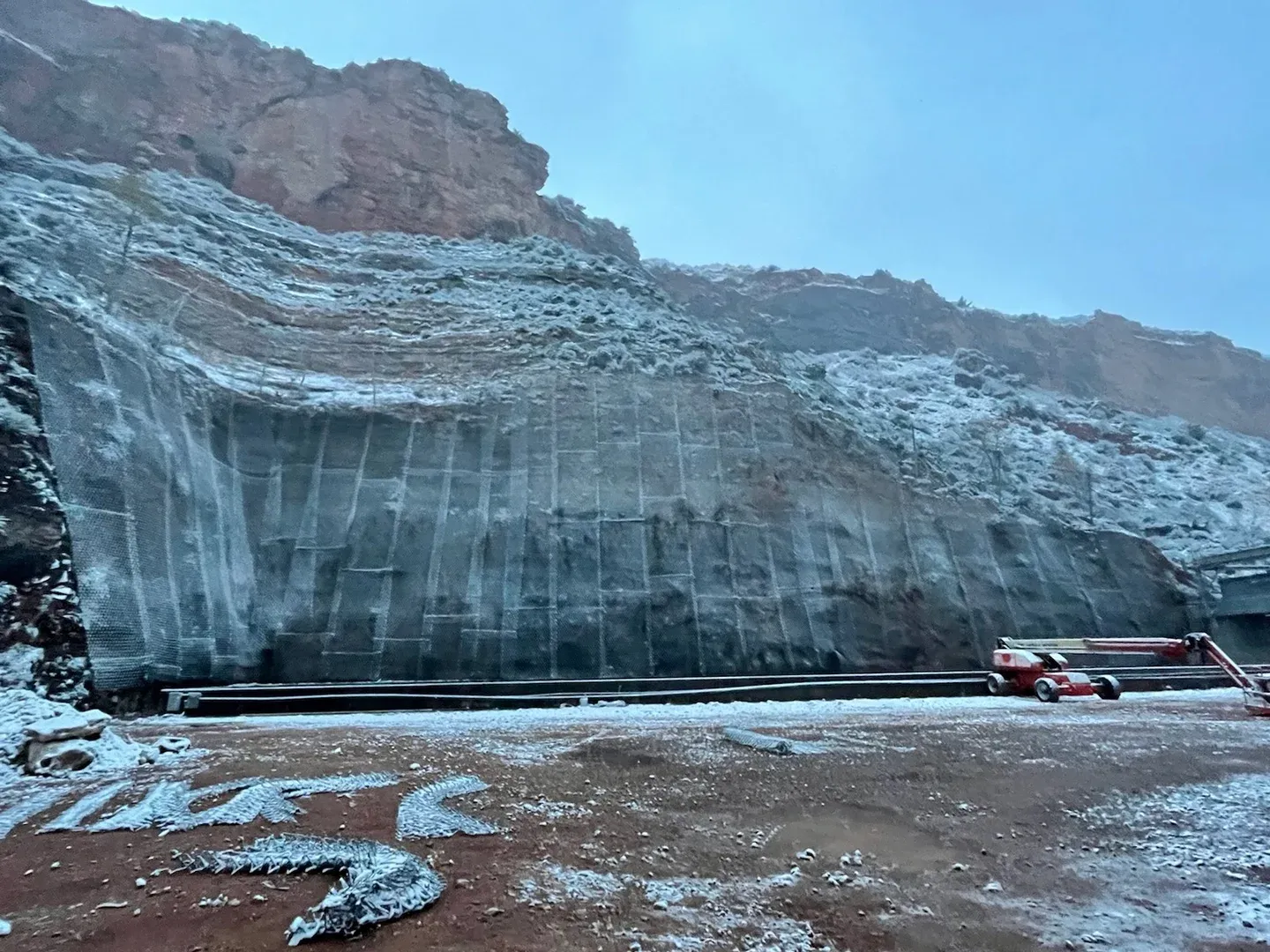
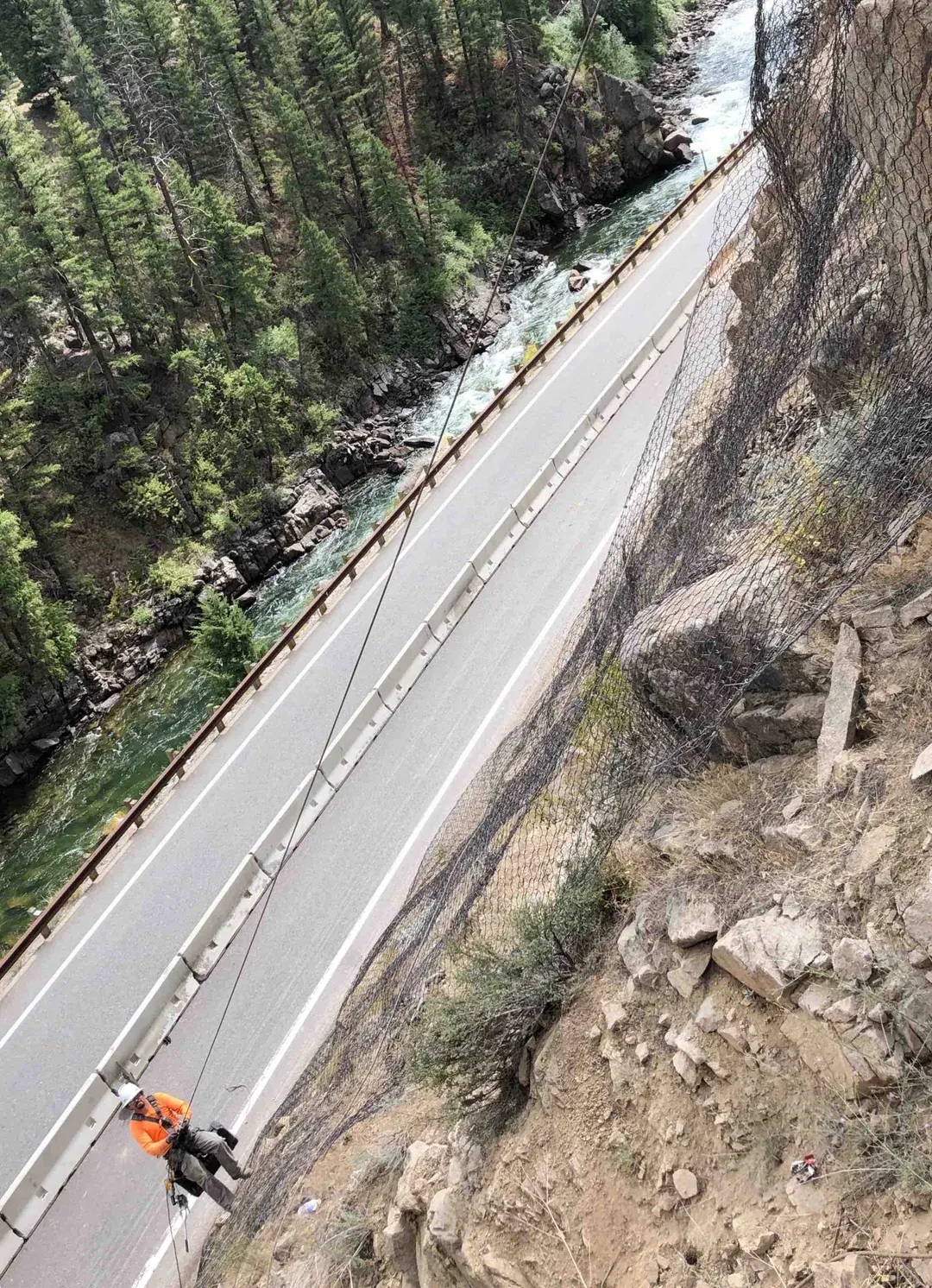
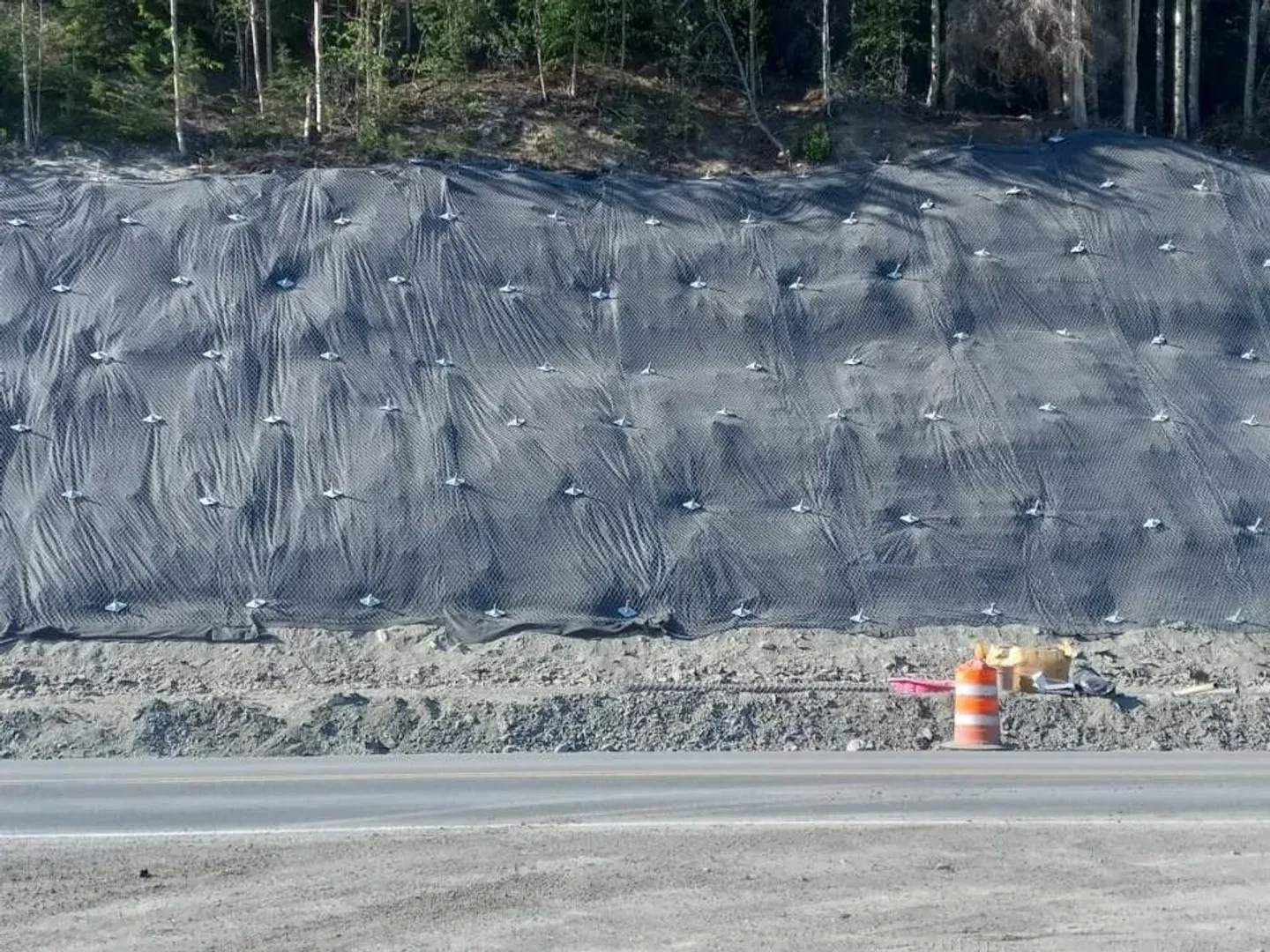
Draped mesh, also called rockfall drapery, is a passive containment system formed by a continuous panel of steel mesh hung from a single row of anchors at the slope crest. Gravity tensions the mesh against the rock face, with no per-block drilling required across the slope. Detached blocks travel between the mesh and the rock, decelerate from successive impacts and friction, and exit at a controlled bottom edge into a catchment ditch, berm, or backstop barrier at the toe.

The system is the workhorse treatment on tall, persistently weathering rock cuts where the source release rate is too high for episodic rock scaling alone and the slope is too long for face-anchored systems like pinned mesh. On highway and rail corridors, drapery pairs with rockfall barriers at the toe and is sized under the FHWA Rockfall Hazard Rating System and the FHWA Rockfall Catchment Area Design Guide.

What Is Draped Mesh?

Draped mesh is a passive rockfall mitigation system in which a continuous panel of steel wire mesh is hung from a single row of top-of-slope anchors and gravity-tensioned against the rock face. The mesh is unattached across the body of the slope, so detached blocks are intercepted between the mesh and the rock, slowed by successive impacts and friction during the descent, and discharged at a controlled bottom edge into an engineered catchment ditch, berm, or backstop barrier at the toe.

US highway practice for drapery was codified through the FHWA Rockfall Hazard Rating System (Pierson, Davis, and Van Vickle, FHWA-OR-EG-90-01, 1990) and the FHWA Rockfall Catchment Area Design Guide (Pierson, Gullixson, and Chassie, FHWA-OR-RD-02-04, 2001), which together drive site selection and toe-of-slope geometry. The dominant US drapery product is double-twisted hexagonal steel wire mesh specified per ASTM A975, supplemented by high-tensile diamond mesh (Geobrugg ROCCO and equivalents) for larger blocks and longer slope lengths. Drapery is now standard treatment on state DOT and Class I rail corridors with persistent freeze-thaw release, on quarry highwalls, and on post-wildfire slopes shedding loose material.

Key Benefits

  • Top-anchor-only drilling, no per-block face anchors
  • Tolerates high source-release rate without progressive damage
  • Rapid deployment for emergency rockfall control
  • 50+ year service life with galvanized or PVC-coated mesh
  • Compatible with rope-access installation on vertical and overhanging faces
The Engineering

How Draped Mesh Works

How the system carries load in service, and how we build it on site.

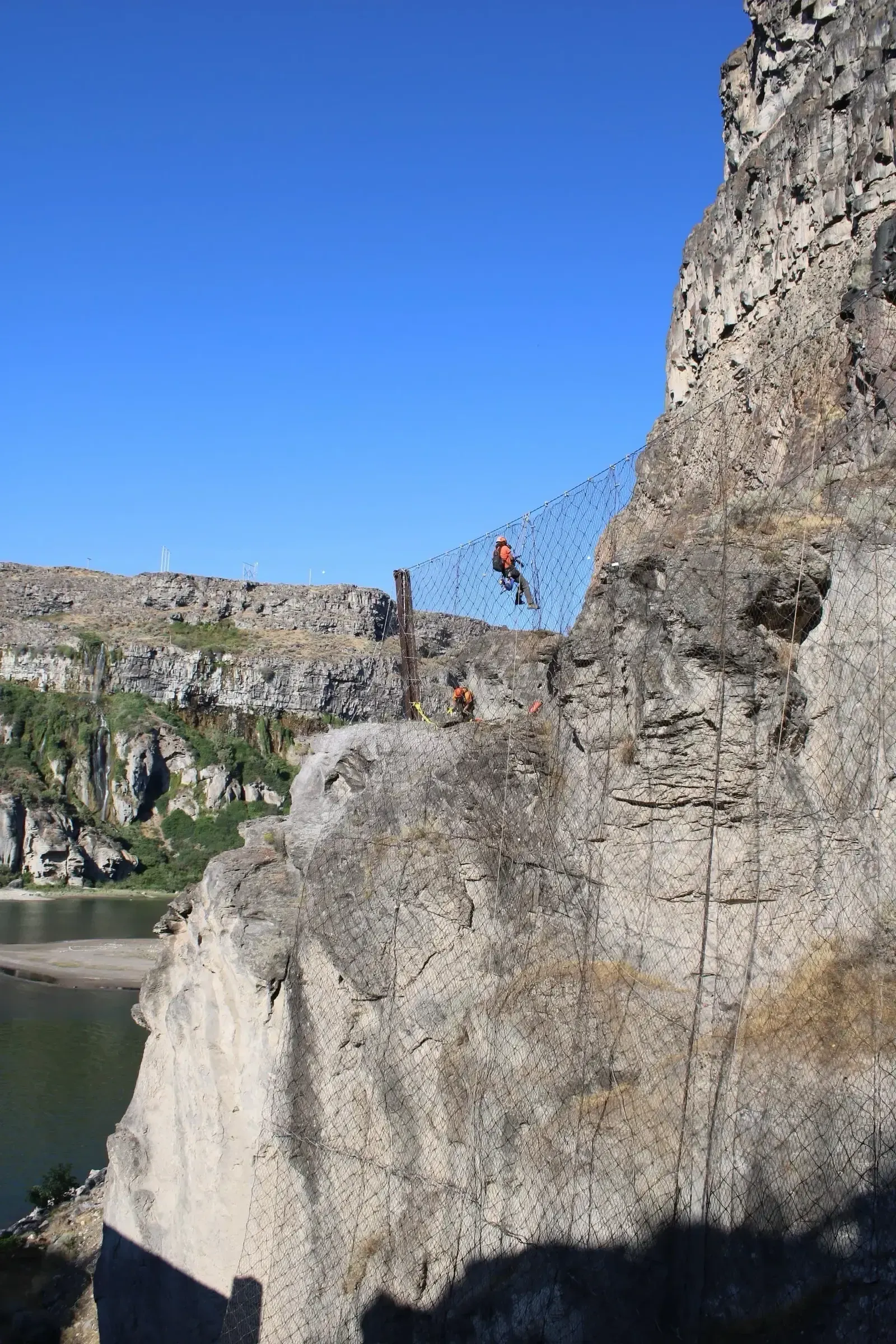
Construction is anchor-first, mesh-second. Crews drill a row of top anchors along the slope crest, typically 0.6 to 1.0 in (15 to 25 mm) threadbar embedded 5 to 15 ft into competent rock or soil at 10 to 50 ft on-center. A continuous perimeter cable is threaded through the anchor heads and tensioned to provide a uniform support along the crest. Mesh panels (8 to 13 ft wide rolls) are deployed from the crest using helicopter, crane, telehandler, or hand-feed depending on access, and rope-access crews lace the seams between panels with stainless or galvanized clips. The bottom edge is left open above the catchment area unless project geometry requires attachment to a toe-wall or anchor row.

In service, the load path is gravity-driven. The mesh self-weights against the rock face, generating contact friction along its full length. When a block detaches, it impacts the mesh, transferring kinetic energy through the wire pattern into the perimeter cable and then into the top anchor row. Local mesh deflection absorbs the first impact, the block decelerates as it ricochets between mesh and rock during its descent, and the catchment ditch at the toe absorbs the residual energy. Because no fixed face anchors restrain the mesh between top and bottom, the system tolerates a high source rate without progressive damage, which is the central advantage over face-anchored alternatives.

1

Top Anchor Installation

Drill a row of crest anchors at 10-50 ft on-center, 5-15 ft into competent rock or soil per design pull-out capacity.

2

Perimeter Cable Tensioning

Thread a continuous wire-rope cable through the anchor heads and tension it along the crest to support the mesh.

3

Mesh Deployment

Unroll mesh panels (8-13 ft wide) from crest to toe using helicopter, crane, telehandler, or hand-feed.

4

Seam Lacing & Edge Termination

Lace panels together with stainless or galvanized clips and terminate the bottom edge above the catchment area.

System Variants

Drapery System Variants

Type 01

Double-Twisted Hexagonal Mesh

The standard product for general drapery, double-twisted hexagonal wire mesh (Maccaferri, Sintex, equivalents) is governed by ASTM A975 and supplied in 8 to 13 ft wide rolls of galvanized or PVC-coated steel wire. Tensile strength runs 30 to 50 kN/m, sufficient for typical rockfall block sizes under one ton. The double-twist pattern resists unraveling when individual wires fail under impact, which is the failure mode that disqualifies single-twist chain link from drapery use on high-consequence corridors.

Type 02

High-Tensile Diamond Mesh

When block sizes or release energies exceed the working range of hexagonal mesh, high-tensile steel mesh in a diamond pattern (Geobrugg ROCCO or equivalent) is specified. The wire grade is 1,770 N/mm² and system capacity reaches 150 kN/m, roughly three to four times standard hex mesh. The same drapery construction sequence applies, top anchors plus perimeter cable, but the heavier mesh handles larger blocks, longer slope lengths, and higher freeze-thaw release rates without permanent deformation.

Type 03

Hybrid Drape and Pinned

On corridors where the upper slope releases ongoing weathered material but the lower slope sits adjacent to a roadway or rail line, drapery on the upper face is transitioned to a pinned mesh system on the lower face. The upper section catches and guides debris while the lower section actively restrains blocks where falling rock cannot be tolerated. This is the standard configuration for highway rock cuts where catchment-ditch geometry alone is insufficient near the travel lane.

Side By Side

Drape vs Other Rockfall Systems

VS

Drape vs Pinned Mesh

The fundamental axis is passive containment versus active restraint. Drape hangs from the crest only, gravity-tensioned, and accepts that rocks will detach and travel down between the mesh and the slope into a catchment area. Pinned mesh is anchored across the entire slope with a grid of rock bolts or soil nails on a 6 to 10 ft pattern, holding loose material in place at the source. Drape is faster to install, requires drilling only along the crest, and tolerates ongoing release. Pinned is preferred where rocks must not move at all, near roadways without adequate catchment, above buildings, and at portal mouths.

VS

Drape vs Rockfall Barrier

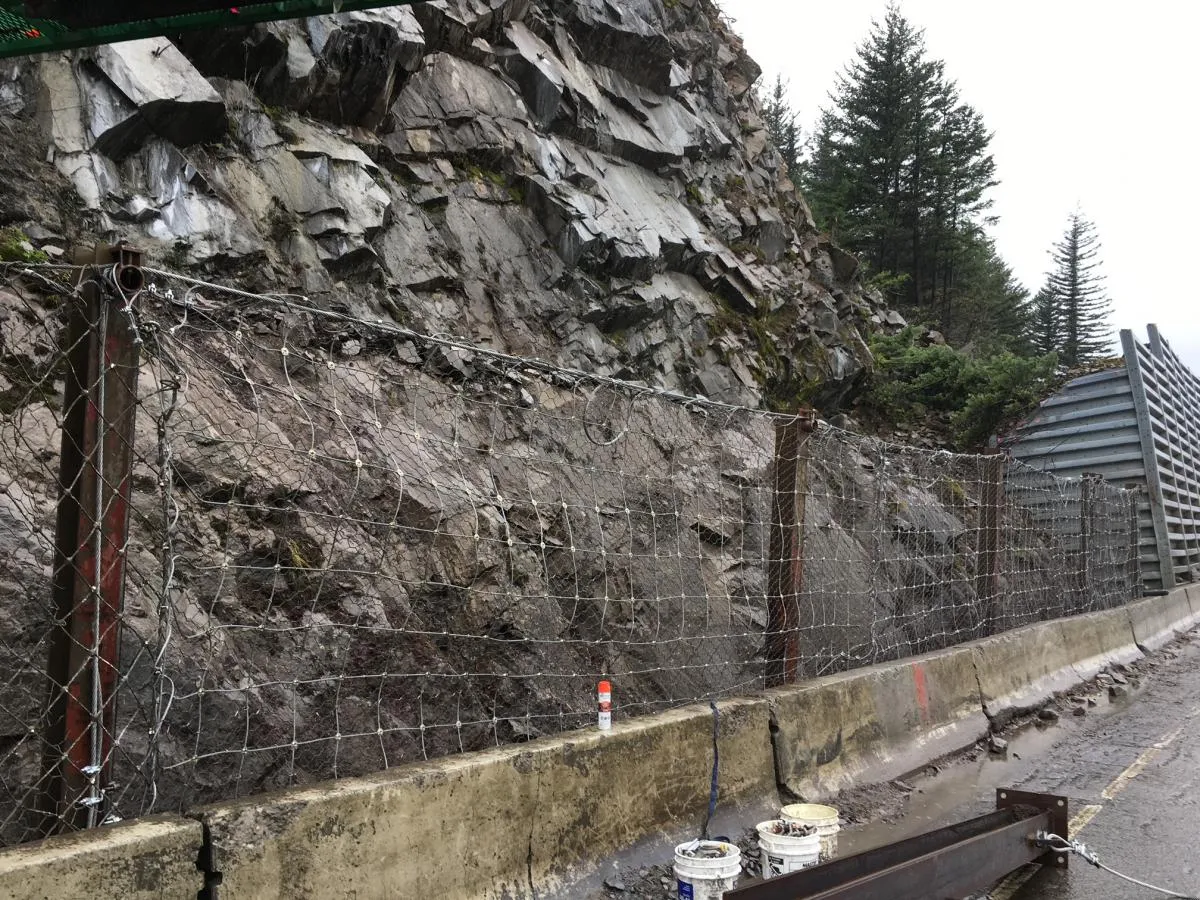
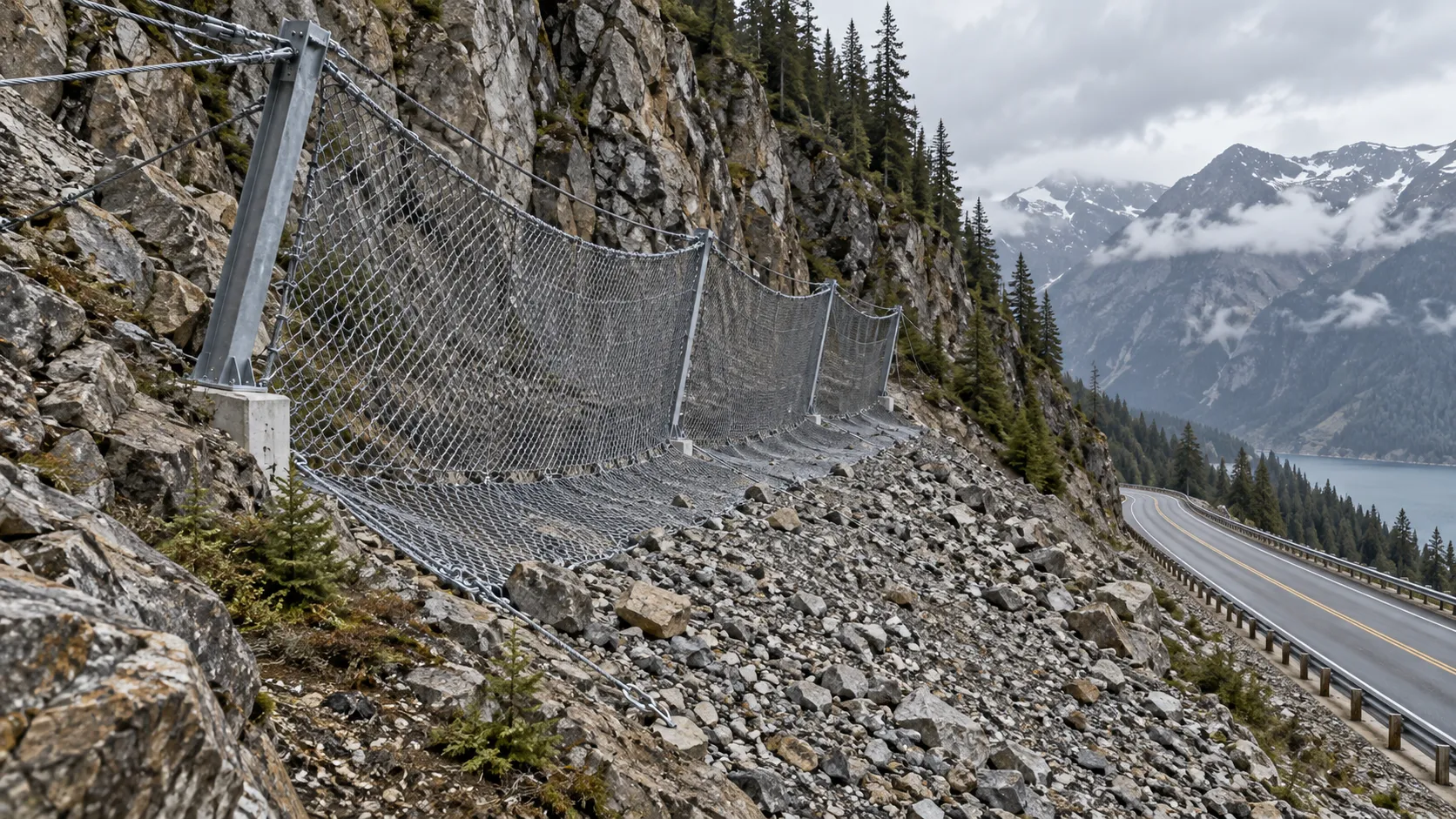
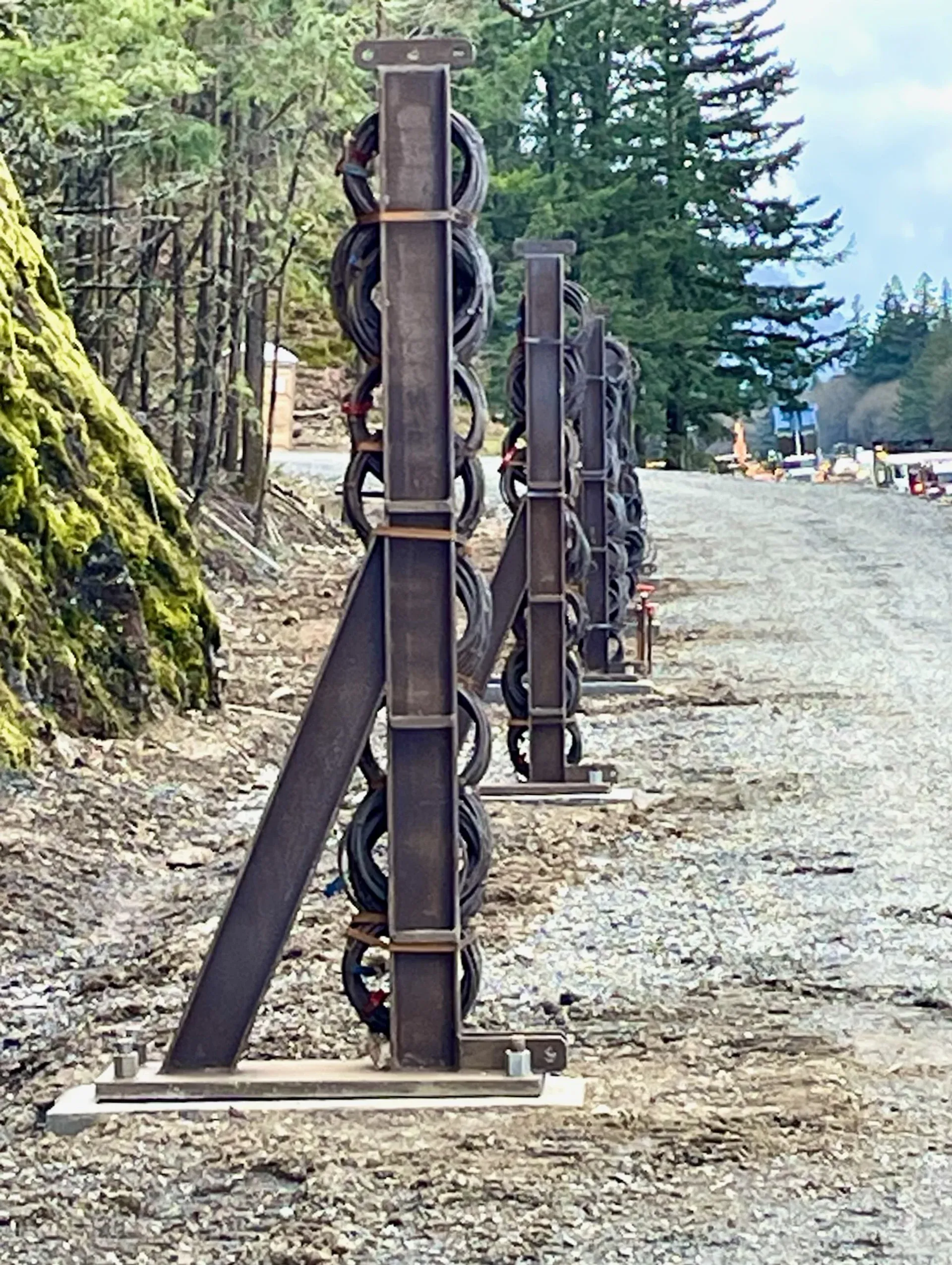
Drape is slope-mounted and runs the full height of the cut. A rockfall barrier is a free-standing fence at or below the toe with hinged steel posts and a flexible ring or cable net rated to a specific impact energy, typically 100 to 10,000+ kJ. Drape catches debris where it releases and channels it down a controlled descent, barriers stop debris that has already accelerated through free-fall or roll. Drape is the right tool when the slope is too tall for a single barrier to capture all trajectories, when source release is continuous rather than episodic, or when the catchment area at the toe is constrained. Many corridors run both: drape handles the persistent-release case and barriers backstop the high-energy events.

VS

Hexagonal vs High-Tensile Drape

The selection axis is wire strength versus block size. ASTM A975 hexagonal mesh is supplied at 30 to 50 kN/m system capacity and is appropriate for sub-ton blocks at typical highway rock-cut energies. High-tensile diamond mesh (1,770 N/mm² wire, 150 kN/m system) is specified when the design block exceeds one ton, when the slope length exceeds the 100 ft typical hex range, or when freeze-thaw release rates produce frequent multi-block events. The drapery configuration and anchor layout are the same, only the mesh product changes, and selection is driven by site-specific rockfall analysis under the FHWA RHRS framework. For multi-ton boulder containment, wire rope netting in a drape configuration is used in place of woven mesh.

Not sure which system fits? We'll walk through the tradeoffs for your site conditions.

Talk Through Your Options
Where It Fits

Where Draped Mesh Fits

Drapery is the workhorse rockfall treatment for state DOT and Class I rail corridors that run beneath persistently weathering rock cuts. On highway rock cuts, the system handles the freeze-thaw release rate that would otherwise require recurring rock scaling mobilizations, channeling sub-ton blocks down into a catchment ditch sized per the FHWA Rockfall Catchment Area Design Guide.

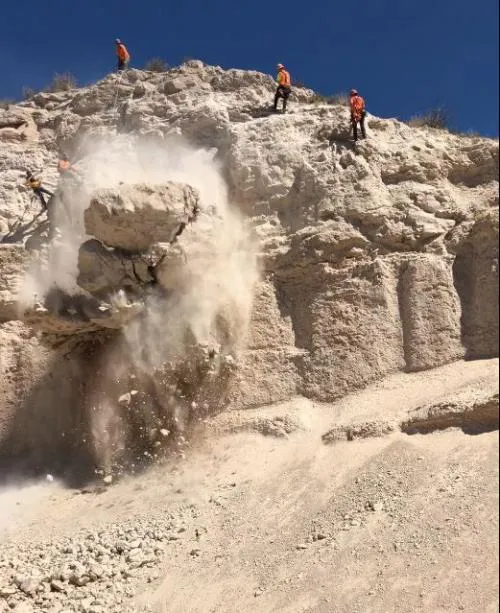
Mining and quarry highwalls use drapery to contain ongoing release from active or post-production faces, often after controlled blasting has produced the final pit wall, so production can continue beneath a stabilized highwall with greater clear distance than highway practice typically allows.

Post-wildfire slopes are a third major application. Vegetation loss exposes the rock substrate to direct weathering and accelerates the source rate, drapery is deployable in days, often before the first significant rainfall season, and pairs with debris flow barriers at the toe for combined rock and debris control.

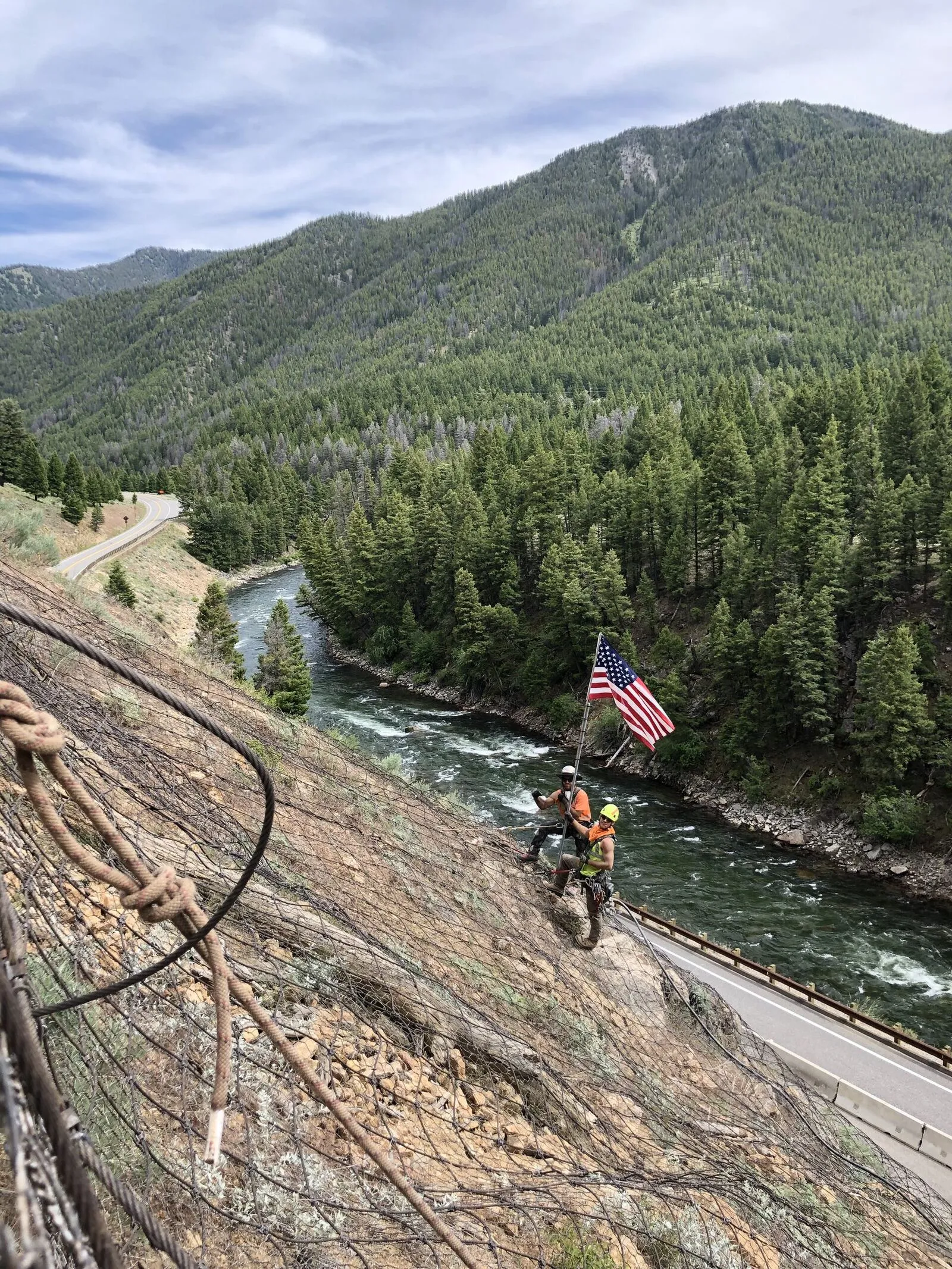
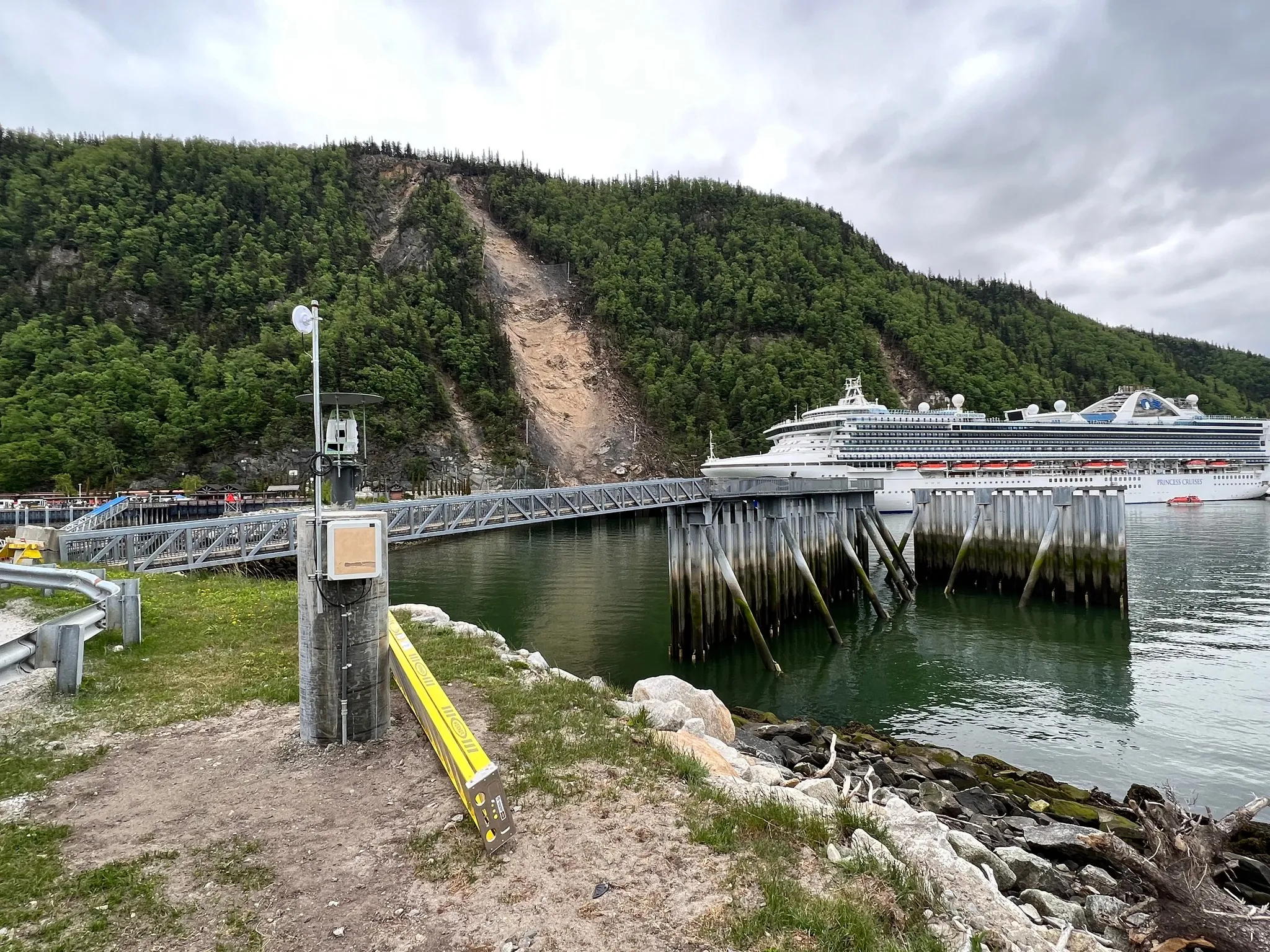
Steep, inaccessible terrain drives the fourth common case. Rope-access crews can install crest anchors and lace mesh on faces where vehicle-mounted drilling is impossible, including the vertical and overhanging cliffs typical of canyon rail corridors, port rockfall sites, and remote mountain highways.
Highway and rail rock-cut corridors with persistent freeze-thaw release
Mining and quarry highwalls with active source rate
Post-wildfire slopes shedding loose debris
Tall, rope-access-only cliffs above transportation infrastructure
Emergency rockfall mitigation following slope failures
Canyon corridors and waterfront port rockfall sites
Benefits

Key Advantages

Crest-Only Drilling

Anchors are required only along the slope crest, not across the face, which eliminates the high cost and schedule of face-bolt drilling on tall slopes.

High Source-Rate Tolerance

The mesh accepts ongoing block release without losing capacity, debris travels down the system into the catchment area instead of accumulating against fixed face anchors.

Rapid Deployment

Drapery can be installed in days for emergency rockfall control, often before the first rainfall season after a wildfire or slope failure.

Steep Terrain Capability

Rope-access deployment allows coverage of vertical and overhanging faces where vehicle-mounted drilling is impossible.

Predictable Maintenance

Periodic catchment cleanout maintains capacity, the mesh itself requires only inspection of crest anchors and seams over its 50+ year service life.

Engineering

Technical Considerations

Soil/Rock Conditions

Top anchors must reach competent rock or soil. Slope face conditions determine mesh type selection: hexagonal mesh for sub-ton blocks, high-tensile diamond mesh for blocks above one ton or longer slope lengths.

Groundwater

Drainage is unimpeded, mesh systems do not trap water against the slope. Weep drains may be integrated where seepage is concentrated.

Load Capacity

System strength runs 30-50 kN/m for ASTM A975 hexagonal mesh and up to 150 kN/m for high-tensile diamond mesh. Wire rope drape configurations handle multi-ton block impacts.

Spacing

Top anchor spacing depends on mesh weight, slope angle, and wind loading. Edge anchors and perimeter cable tensioning secure the perimeter and panel seams.

Installation Method

Mesh panels deployed from crest using helicopter, crane, telehandler, or rope-access feed. Panels laced together with stainless or galvanized clips at the seam.

Equipment Used

  • Helicopter or crane for mesh deployment
  • Rope-access rigging systems
  • Drill rigs for crest anchor installation
  • Lacing clips and seam tools
  • Perimeter cable tensioning equipment

Limitations

  • Requires an engineered catchment area at the slope toe
  • Containment only, not source-control like pinned mesh
  • Catchment cleanout required after major release events
  • High wind exposure may require supplemental edge anchoring

Technical Specifications

Mesh Type
Double-Twisted Hex (ASTM A975) / High-Tensile Diamond
Wire Diameter
3 mm to 4 mm
Coating
Galvanized Class A / PVC Coated
Top Anchor Spacing
10 ft to 50 ft on-center
Codes And References

Standards & References

FHWA

FHWA-OR-EG-90-01

Rockfall Hazard Rating System (Pierson, Davis, Van Vickle 1990)

The canonical state-DOT framework for prioritizing rockfall mitigation work. RHRS scores slope geometry, block size, climate, ditch effectiveness, and historic rockfall to drive treatment selection. Drapery is one of the standard outputs for high-scoring slopes.

FHWA

FHWA-OR-RD-02-04

Rockfall Catchment Area Design Guide (Pierson, Gullixson, Chassie 2001)

The design reference for the catchment ditch at the toe of a drapery system. Provides slope-and-ditch geometry charts based on full-scale rockfall trajectory testing. A drapery design without a sized catchment is not a complete design.

ASTM

ASTM A975

Double-Twisted Hexagonal Steel Wire Mesh

Material specification for the dominant US drapery mesh product. Defines wire diameter, coating (Class A galvanized or polymer), mesh opening, and tensile testing protocols. Typically referenced directly in DOT special provisions.

Gallery

Our Work in Action

Expertise

Why Choose Rock Supremacy for Draped Mesh

Rope-Access Crews

SPRAT/IRATA-trained technicians install drapery on vertical and overhanging faces where vehicle-mounted equipment cannot work.

Emergency Mobilization

48-hour mobilization for active rockfall events threatening highway, rail, and mining infrastructure.

Heavy Mesh Handling

In-house rigging for helicopter, crane, and telehandler deployment of large mesh panels in steep terrain.

Multi-Sector Capability

Drapery installed for state DOTs, Class I railroads, mining operators, and post-wildfire recovery projects across the Pacific Northwest and Southeast.

Integrated Scope

Self-perform scaling, crest-anchor drilling, mesh deployment, and catchment design with our own crews, no subcontractor handoffs between source removal and containment work.

Questions

Draped Mesh Systems FAQ

Draped mesh is a passive rockfall control system that hangs steel wire mesh from a single row of anchors at the slope crest. Gravity tensions the mesh against the rock face, and detached blocks are intercepted between the mesh and the slope, slowed by friction and successive impacts during the descent, and discharged at the bottom into a catchment ditch or backstop barrier at the toe. No drilling is required across the body of the slope.
Draped mesh is anchored only at the slope crest and gravity-tensions against the rock face, accepting that blocks will detach and travel down to a catchment area. Pinned mesh is bolted to the slope on a 6-10 ft grid of rock bolts or soil nails, actively holding loose material in place at the source. Drape is faster and tolerates ongoing release; pinned is preferred where rocks must not move at all, near roadways, buildings, or portal mouths.
US highway practice is governed by the FHWA Rockfall Hazard Rating System (Pierson, Davis, Van Vickle 1990, FHWA-OR-EG-90-01) for treatment prioritization and the FHWA Rockfall Catchment Area Design Guide (Pierson, Gullixson, Chassie 2001, FHWA-OR-RD-02-04) for toe-of-slope ditch geometry. The dominant mesh material is specified per ASTM A975 (double-twisted hexagonal steel wire mesh). State DOTs typically reference these documents directly in special provisions.
Catchment width and depth come from the FHWA Rockfall Catchment Area Design Guide based on slope height, slope angle, and ditch shape. The guide provides geometry charts derived from full-scale rockfall trajectory testing. As a planning starting point, taller and steeper slopes need wider, deeper ditches, but the formal design must follow the FHWA charts for the specific site geometry. A drapery without an adequate catchment is not a complete system.
Standard hexagonal mesh (ASTM A975) is rated for sub-ton blocks. High-tensile diamond mesh (1,770 N/mm², 150 kN/m system capacity) handles blocks up to several tons. For multi-ton boulder containment, wire rope netting in a drape configuration is specified instead of woven mesh. Block-size sizing is part of the rockfall analysis driven by the FHWA RHRS framework.
Crest anchors are typically 0.6-1.0 in (15-25 mm) threadbar drilled and grouted 5-15 ft into competent rock or soil at 10-50 ft on-center. Drilling is performed from a crest road where one exists, or by rope-access crews with portable rigs where it does not. A continuous perimeter cable is threaded through the anchor heads to support the mesh. Anchors are pull-tested to verify design capacity before mesh deployment.
Installation rate depends on access, slope height, and mesh type. With crest road access and helicopter or telehandler deployment, crews routinely install large coverage areas per day. Rope-access-only slopes are slower because anchors and mesh must be staged from the rope. Emergency drapery for active rockfall events can often be operational within days of mobilization.
The mesh itself requires only periodic inspection of crest anchors, perimeter cable tension, and seam lacing. Catchment cleanout is the recurring maintenance item: remove accumulated debris from the ditch annually or after major release events to restore catchment capacity. Galvanized and PVC-coated mesh products achieve 50+ year service life with minimal intervention beyond inspection.
Yes. Drapery is well-suited to vertical and overhanging faces because the mesh self-tensions under gravity against the rock and only the crest anchors require drilling. Rope-access crews handle anchor installation and mesh lacing on faces where vehicle-mounted equipment cannot operate. Canyon rail corridors, port rockfall sites, and tall mountain highway cuts are common rope-access drapery applications.
Testimonials

Client Testimonials

Trusted by DOTs, engineering firms, and property owners nationwide.

Contact

Deploy Us

Ready to discuss your project? Our team is standing by to assess your site conditions and develop a custom solution using Draped Mesh Systems and other proven techniques.

Emergency (24/7)

(541) 383-7625

Bidding & Estimates

Info@RockSupremacy.com

Headquarters

Western Division (HQ)
65147 N Hwy 97
Bend, OR 97701
Eastern Division
915 Millennium Ct
Blountville, TN 37617

Licensed in CO, UT, WY, ID, MT, CA, WA, OR, TN, VA

Request Consultation