Gabion Baskets

Gabion Baskets

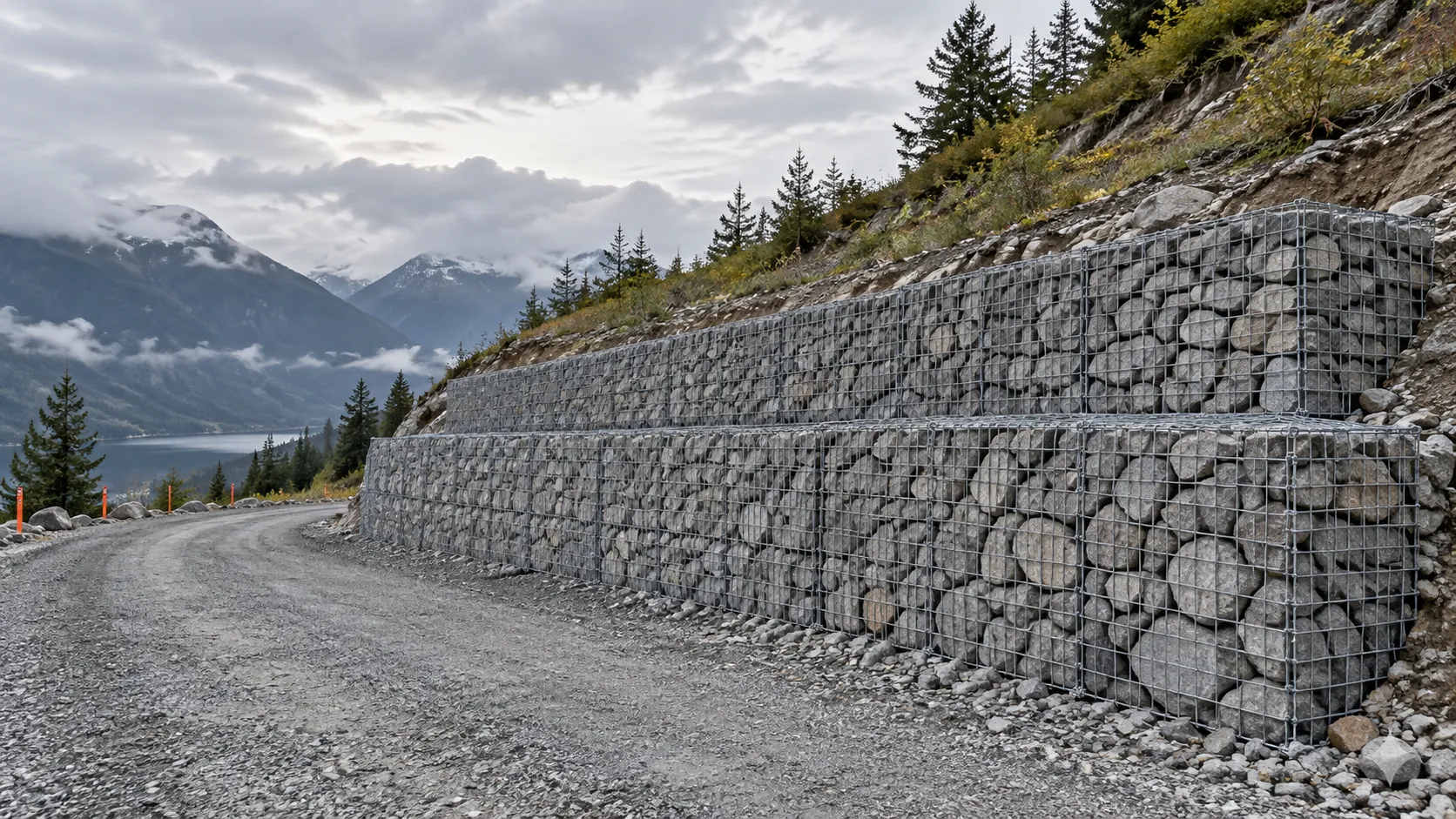
Gabion baskets are rock-filled wire mesh containers that act as flexible gravity walls, channel armor, and slope buttresses on infrastructure projects. They are manufactured to ASTM A975 (double-twist hexagonal mesh) or ASTM A974 (welded wire fabric) and used to retain earth, armor streambanks, and protect bridge foundations against scour.

Up to 30 ft
Gravity Wall Height
6:1-10:1
Wall Batter Ratio
ASTM A975 / A974
Wire Mesh Standards
50-75+ Yr
Galvanized / PVC Life
Overview

Understanding Gabion Baskets

Gabion baskets are rock-filled wire mesh containers that act as flexible gravity retaining walls, channel armor, and slope buttresses. The system was developed by Officine Maccaferri in northern Italy in the 1880s for bank protection on the flooding Reno River, the source of the Reno mattress name still used today for the flat horizontal variant. Modern gabions are specified to ASTM A975 for double-twisted hexagonal mesh, the international workhorse, and to ASTM A974 for welded wire fabric, common on US transportation projects. The mesh assembly lets the wall conform to settlement and frost movement without cracking, and the rock fill drains freely so hydrostatic pressure never accumulates behind the face.

On bridge and culvert sites, gabions and MSE walls often work in combination, gabions armor the streambank or culvert toe against scour per FHWA HEC-23, while the MSE wall above retains the roadway embankment, giving a single project both hydraulic protection and structural retention. On steep highway corridors gabion gravity walls pair with horizontal drains to dewater the slope behind the wall, and on post-fire watersheds Reno mattress armor in the channel pairs with upstream debris flow barriers for a complete watershed-scale countermeasure.

What Are Gabion Baskets?

Gabion baskets are rock-filled wire mesh containers that function as flexible gravity walls and as channel and scour armor. The system originated in the 1880s with Officine Maccaferri's bank protection work on the Reno River in northern Italy, and the flat horizontal variant still carries the name Reno mattress. The modern product is a prefabricated mesh basket assembled on site, filled with 4 to 8 inch angular durable rock, laced or welded into stacked courses with a designed face batter, and backfilled in lifts as it rises.

Two parallel ASTM standards govern the wire form. ASTM A975 covers the historical Maccaferri double-twisted hexagonal mesh, where two wires twist together at each cell intersection to produce a redundant load path so a single damaged wire cannot unzip the panel. ASTM A974 covers welded wire fabric gabions, where wires are welded at each grid intersection for a more rigid finished face and faster on-site assembly. Wire is heavily zinc galvanized (typically Class 3) for a 50-plus year design life, with a polymer coating layer added in marine, acidic, or de-icing-salt environments to push design life past 75 years.
Key Benefits

  • Flexible mesh-and-rock mass conforms to settlement without cracking
  • Free-draining rock fill eliminates hydrostatic pressure
  • Structurally complete on lacing day, no concrete cure window
  • Vegetation establishes through the mesh for natural integration
  • Local rock fill sourcing reduces trucking and embodied carbon
The Engineering

How Gabion Gravity Walls Carry Load

How the system carries load in service, and how we build it on site.

A gabion wall resists overturning and sliding through its own weight. The rock-filled mass has an effective unit weight of roughly 110 to 125 pounds per cubic foot depending on rock density and packing, which combined with the designed face batter (typically 6:1 to 10:1 horizontal to vertical) and base friction on the prepared foundation generates the resisting moment that holds the retained earth. Internal stability is supplied by the interlocking angular rock fill held inside the mesh envelope, and load transfers between baskets through the laced or welded connections so the wall behaves as a single gravity block rather than a stack of independent units.

Construction starts with a level foundation cut to design grade, with a filter geotextile (typically AASHTO M 288 Class 2 nonwoven) placed against the retained soil to prevent fines from migrating into the rock fill. Empty baskets are unfolded, assembled in place, and tied to the panels of adjacent and stacked baskets. Rock fill is placed in lifts and hand-packed at the wall face for visual quality and density, with mechanical placement accelerating the interior fill. Backfill is compacted in matching lifts behind each course, and successive courses are set back at the design batter as the wall rises. Because there is no concrete cure time, the wall is structurally complete the moment the top course is laced and filled, which is the decisive advantage on emergency washout repair and short construction windows.

1

Foundation Preparation

Excavate to design grade, level the bearing surface, and install AASHTO M 288 Class 2 filter geotextile against the retained soil.

2

Basket Assembly

Unfold and assemble ASTM A975 or A974 mesh baskets in place, tying cell walls and end panels for course-one layout.

3

Rock Fill and Hand Packing

Place 4 to 8 inch angular durable rock, hand-packing the visible face for density and finish while accelerating interior fill mechanically.

4

Lacing and Course Stacking

Lace adjacent and stacked baskets into a single unified gravity block, set the next course back at the design batter (6:1 to 10:1).

5

Backfill and Top Cap

Compact retained-earth backfill in lifts matching each course, install the top cap with continuous mesh closure to seal the wall against debris and weathering.

System Variants

Gabion System Variants

Type 01

Double-Twist Hexagonal Mesh (ASTM A975)

The historical Maccaferri pattern and the international workhorse of gabion construction. Hexagonal openings are formed by twisting two wires together at each cell intersection, producing a redundant load path so that a single damaged wire cannot unzip the panel. Double-twist mesh accepts large deformations without losing integrity, making it the preferred form on settling foundations, in channels with periodic high flow, and in seismic regions. Used for both vertical-face gravity walls and Reno mattress channel armor.

Type 02

Welded Wire Fabric (ASTM A974)

The welded pattern common on US transportation projects, with wires welded at each grid intersection rather than twisted. Welded mesh assembles faster (no on-site lacing of cell walls is required), produces a more uniform vertical face, and resists basket bulging under high fill loads better than twisted mesh. The tradeoff is reduced flexibility, a single broken wire opens a square in the panel without the redundant twist to retain it. Welded gabions are well suited to highway retaining walls and abutment work where face quality and assembly speed matter more than extreme deformation tolerance.

Type 03

Reno Mattresses for Channel Armor

Flat gabion units 6 to 18 inches thick, used to armor streambanks, culvert aprons, spillways, and bridge approach channels against erosion and scour. Reno mattresses are filled with 3 to 5 inch rock and laid on a prepared subgrade with filter geotextile beneath. Compared to loose riprap of equivalent armor stone size, the mattress contains the stones inside a wire envelope, which lets the system survive design flow events that would mobilize loose riprap and lets it be installed at near-vertical face angles where loose stone simply rolls down. Reno mattresses are an established Bridge Scour Countermeasure under FHWA HEC-23.

Side By Side

Gabion vs Other Retaining and Armor Systems

VS

Gabion Wall vs MSE Wall

Both are flexible, settlement-tolerant gravity systems, but the structural axis is different. A gabion wall carries load through its own mass, the rock-filled mesh assembly is the wall, with no soil reinforcement behind the face. MSE walls carry load by reinforcing the retained earth itself with geosynthetic or steel strap layers tied to facing panels, so the wall and the backfill function as a single composite earth structure. Gabions top out economically around 25 to 30 feet for a single-stem gravity section and excel at remote channel and bank work; MSE walls scale economically to 100 feet and beyond and dominate highway embankment and bridge approach retention.

VS

Gabion Wall vs Cast-in-Place Concrete Wall

The decisive axis is rigidity and drainage. A cast-in-place reinforced concrete wall is a stiff continuous element with effectively zero permeability, which makes it sensitive to differential settlement (cracks form), to hydrostatic pressure (requires a separate drainage layer behind the face), and to long concrete cure schedules. A gabion wall is flexible, fully self-draining through the rock fill, and structurally complete the moment the last course is laced. The concrete wall wins on tight-tolerance vertical face requirements and on the highest-load, lowest-deflection applications. The gabion wall wins on settlement-prone foundations, channel and streambank work, and remote sites where ready-mix delivery is impractical.

VS

Reno Mattress vs Loose Riprap

For channel armor and scour countermeasure work, the question is containment. Loose riprap relies on the size and weight of individual armor stones to resist mobilization at the design flow velocity, with stones rolling and reseating after high events but progressively deflating away from the design profile. A Reno mattress contains the stones inside a wire envelope, so the design profile is locked in, smaller fill stones can be specified for the same design velocity, and the mattress can be laid at near-vertical bank angles where loose riprap simply slides downslope. Loose riprap remains the cheaper option on flat low-velocity reaches; the Reno mattress wins where flow velocity, bank steepness, or the consequence of armor displacement is high.

Not sure which system fits? We'll walk through the tradeoffs for your site conditions.

Talk Through Your Options
Where It Fits

Where Gabion Systems Are Used

Gabion baskets and Reno mattresses are deployed on infrastructure projects where flexibility, free drainage, and channel-compatible armor are decisive. On state and federal highway work they retain cut and fill slopes along corridors, armor culvert headwalls and outlets, and protect bridge abutments against scour per FHWA HEC-23. In post-wildfire watershed work they pair with upstream debris flow barriers by armoring the receiving channel below the barrier line. On stream and river restoration projects they stabilize eroding banks while permitting eventual vegetation establishment for habitat value. On emergency washout and storm-damage repair they go in fast, with no concrete cure window, and tolerate the saturated foundations and ongoing settlement that follow these events. On rural and remote sites with limited concrete-batching access, gabions remain the most cost-effective retaining option in the 6 to 30 foot height range.

Highway and roadway retaining walls
Streambank and riverbank stabilization
Bridge abutment and pier scour countermeasure
Culvert headwall and outlet armoring
Post-fire channel armor below debris flow barriers
Slope buttressing and toe stabilization
Emergency washout and storm-damage repair
Benefits

Key Advantages

Conforms to Settlement

The mesh-and-rock mass deforms without cracking, ideal for soft compressible foundations or post-construction subsidence where a rigid wall would fail.

Self-Draining Mass

Rock fill is fully permeable, eliminating the hydrostatic pressure that drives the majority of rigid wall failures. No separate weep drain installation in the wall body itself.

No Cure Time

Walls are structurally complete the day they are laced and filled, the decisive advantage for emergency washout repair and short construction windows.

Channel-Compatible Armor

Reno mattress variants are an FHWA HEC-23 bridge scour countermeasure, locking the design profile against design flow events that mobilize loose riprap.

Local Material Sourcing

Most rock fill is sourced from a quarry near the site, reducing trucking costs, embodied carbon, and project schedule compared with imported concrete or proprietary panels.

Engineering

Technical Considerations

Soil/Rock Conditions

Foundation must be cut to design grade and proof-rolled. Soft compressible subgrades may require geotextile separation, working platform, or ground improvement before basket placement.

Groundwater

Gabion mass is fully self-draining. AASHTO M 288 Class 2 nonwoven filter geotextile is installed against the retained soil to prevent fines migration into the rock fill.

Load Capacity

Gravity wall design per industry references (Maccaferri / NCMA) sized for wall height, batter, surcharge, and seismic loading. Internal stability provided by rock interlock inside the laced or welded mesh envelope.

Spacing

Wall batter typically 6:1 to 10:1 (horizontal to vertical). Each successive course set back at the design batter. Reno mattress channel armor laid continuous with seamed lacing between mattresses.

Installation Method

Baskets assembled on site, filled in place with mechanical placement of interior rock and hand packing of the visible face. Laced or welded into a unified gravity block.

Equipment Used

  • Excavator for foundation cut and rock placement
  • Hand tools for basket assembly and lacing
  • Pneumatic ring gun for accelerated lacing on large jobs
  • Local quarry rock supply (4 to 8 in angular)
  • AASHTO M 288 Class 2 filter geotextile
  • Galvanized lacing wire or stainless ring fasteners

Limitations

  • Requires quality angular durable rock fill, sized to the mesh opening
  • Wire coating selection drives life in corrosive (marine, acidic, salt) environments
  • Single-stem gravity section economical to about 30 ft, taller walls require reinforced gabion or shift to MSE
  • Hand-packed face quality is labor-intensive on visible architectural walls

Technical Specifications

Basket Sizes
3' × 3' × 6', 9', or 12' standard
Wire Standard
ASTM A975 (double-twist) or ASTM A974 (welded)
Wire Coating
Class 3 zinc galvanized, or PVC over galvanized
Rock Fill
4 to 8 in clean angular durable rock
Filter Geotextile
AASHTO M 288 Class 2 nonwoven
Wall Batter
6:1 to 10:1 (horizontal to vertical)
Reno Mattress Thickness
6, 9, 12, or 18 in
Gravity Wall Height
Up to 30 ft single-stem
Codes And References

Standards & Design References

ASTM

ASTM A975

Double-Twisted Hexagonal Mesh Gabions and Revet Mattresses

Defines wire diameter, mesh opening tolerance, zinc and PVC coating requirements, and panel construction for the historical Maccaferri double-twist hexagonal mesh form. The dominant international gabion specification.

ASTM

ASTM A974

Welded Wire Fabric Gabions and Gabion Mattresses

Parallel specification covering welded wire fabric gabion construction, including coating classes, joint integrity, and panel assembly. Common on US transportation work where assembly speed and uniform face quality drive system selection.

AASHTO

AASHTO M 288

Geotextile Specification for Highway Applications

Class 2 nonwoven survivability spec for the geotextile filter installed behind a gabion retaining wall or beneath a Reno mattress. Prevents fines migration into the rock fill while permitting free pore-water drainage.

FHWA

HEC-23 Vol. 2

Bridge Scour and Stream Instability Countermeasures

FHWA design guidelines for armor and retention countermeasures protecting bridge foundations and approach channels. Reno gabion mattresses and gabion bank protection are covered design-guide options for resistive scour countermeasure use.

Expertise

Why Choose Rock Supremacy for Gabion Baskets

Engineered to ASTM Standards

We specify and install gabion systems to ASTM A975 and A974 wire standards with AASHTO M 288 filter geotextiles, with stamped engineering on infrastructure-grade work.

Remote and Difficult Access

Crews build gabion walls on remote highway corridors, post-fire watersheds, and rope-access channel work where concrete delivery is impractical or impossible.

Scour Countermeasure Design

Reno mattress armor and gabion bank protection designed per FHWA HEC-23 Bridge Scour Countermeasures, with hydraulic and structural requirements integrated on a single drawing set.

Integrated Wall Systems

Gabion gravity walls combined with horizontal drains, soil nailing, or upstream MSE walls when site conditions require a hybrid retaining and drainage solution.

Questions

Gabion Baskets FAQ

A gabion basket is a rock-filled wire mesh container that functions as a flexible gravity retaining wall, channel armor, or slope buttress. Modern gabions are specified to ASTM A975 (double-twist hexagonal mesh, the historical Maccaferri form) or ASTM A974 (welded wire fabric). Baskets are assembled on site, filled with 4 to 8 inch angular rock, and laced into stacked courses with a designed face batter of 6:1 to 10:1. The rock-filled mass resists overturning through its own weight, with no separate concrete pour or proprietary facing required.
A gabion wall carries load by mass. The rock-filled assembly has an effective unit weight of 110 to 125 pcf, which combined with the designed face batter and base friction generates the resisting moment that holds the retained earth. Internal stability comes from the angular rock interlock inside the mesh envelope, with load transferring between baskets through the laced or welded panel connections. A filter geotextile (AASHTO M 288 Class 2) behind the wall blocks fines from migrating into the rock fill while letting groundwater drain freely through the wall face.
Double-twist gabions (ASTM A975) form hexagonal openings by twisting two wires together at each cell intersection, giving a redundant load path so a single damaged wire cannot unzip the panel. Welded wire fabric gabions (ASTM A974) weld the wires at each grid intersection, producing a more rigid finished face and faster on-site assembly. Double-twist mesh accepts larger deformations without losing integrity (better on settling foundations, in channels, and in seismic regions); welded mesh produces a more uniform vertical face and resists fill bulging better (preferred for highway retaining walls and abutments).
Gabion baskets are 3-foot-deep stacked units used to build gravity walls and slope buttresses. Reno mattresses are flat 6 to 18 inch thick units used to armor channel beds, banks, culvert aprons, spillways, and bridge approach channels. Both are wire mesh containers with rock fill, but the geometry is different: baskets stack vertically to retain earth, while mattresses lie on a prepared subgrade to armor against erosion and hydraulic scour. Reno mattresses are an established Bridge Scour Countermeasure under FHWA HEC-23.
A single-stem gabion gravity wall is economical to about 25 to 30 feet, with the resisting mass and face batter sized to the retained-earth surcharge. Above 30 feet, the system shifts to either reinforced gabion (with geosynthetic reinforcement layers tied between courses to extend the structural mass behind the face) or to a different system entirely, typically an MSE wall, which scales economically to 100 feet and beyond. Step-tiered gabion configurations also extend effective height by stacking shorter sections with intermediate benches.
Standard zinc-galvanized gabions (Class 3 coating per ASTM A975) deliver a 50-plus year design life in non-aggressive environments. PVC-coated wire over galvanized substrate extends design life past 75 years and is specified in marine, acidic, de-icing-salt, or industrial-pollutant environments where bare zinc would corrode early. The rock fill itself is permanent, what determines wall life is the wire coating, so coating selection is the central decision when the site is corrosive.
Yes, this is one of the design advantages. Soil and seed migrate into the rock fill voids over time, and root systems establish through the mesh openings, integrating the wall into the surrounding landscape with no ongoing intervention required. On habitat-sensitive stream restoration projects this is intentional bioengineering, with topsoil placed in selected courses during construction and native seed mixes broadcast onto the face. The vegetated wall continues to function structurally while developing a naturalized appearance over a few growing seasons.
Standard fill is 4 to 8 inch clean angular durable rock for vertical baskets, sized larger than the mesh opening so it cannot pass through. Reno mattress fill is typically 3 to 5 inch rock matched to the thinner mattress geometry. Rock must be hard, weather-resistant, and free of organic and fine material. Most projects source fill from a local quarry to reduce trucking and embodied carbon. Rounded river rock is generally not specified, the angular shape is what produces the interlock that gives the assembly its internal stability.
Yes, gabion bank protection and Reno mattress armor are covered countermeasures under FHWA HEC-23 Volume 2 (Bridge Scour and Stream Instability Countermeasures). They're specified to protect bridge abutments and pier foundations against scour caused by design flow events, with the wire envelope locking the armor profile against the displacement that progressively deflates loose riprap of equivalent armor stone size. The mattress can also be installed on near-vertical bank angles where loose stone simply rolls down.
ASTM A975 (double-twist hexagonal mesh) and ASTM A974 (welded wire fabric) are the wire and basket specifications. AASHTO M 288 Class 2 specifies the nonwoven filter geotextile. FHWA HEC-23 Volume 2 covers gabion bank protection and Reno mattress design as bridge scour countermeasures. Gravity wall sizing follows industry references published by Maccaferri and NCMA covering external stability (overturning, sliding, bearing) and seismic loading. Coating class selection follows ASTM A641 (zinc) and the relevant PVC-over-galvanized supplements within ASTM A975/A974.
Testimonials

Client Testimonials

Trusted by DOTs, engineering firms, and property owners nationwide.

Contact

Deploy Us

Ready to discuss your project? Our team is standing by to assess your site conditions and develop a custom solution using Gabion Baskets and other proven techniques.

Emergency (24/7)

(541) 383-7625

Bidding & Estimates

Info@RockSupremacy.com

Headquarters

Western Division (HQ)
65147 N Hwy 97
Bend, OR 97701
Eastern Division
915 Millennium Ct
Blountville, TN 37617

Licensed in CO, UT, WY, ID, MT, CA, WA, OR, TN, VA

Request Consultation