Shotcrete (Dry Mix)

Shotcrete (Dry Mix)

Dry-mix shotcrete is the operator-controlled placement process where dry cement and aggregate are conveyed by compressed air to the nozzle, where the nozzleman meters water in at placement. Portable equipment, real-time water control, and bag-fed supply make dry-mix the right tool for repair, remote-site, intermittent, and overhead-dominant work where wet-mix pump-and-pour logistics do not pay back.

1-3
CY/Hour
5000+
PSI Strength
20-40%
Vertical Rebound
ACI CP-60
Dry-Process Cert
Overview

Understanding Dry-Mix Shotcrete

Dry-mix shotcrete is the operator-controlled placement process where dry cement and aggregate are conveyed by compressed air through a delivery hose, hydrated at the nozzle by water introduced at the manifold, and placed against the work surface by the same airstream. The nozzleman controls water content in real time by valve, the defining feature of the process and the reason ACI CP-60 certifies dry-process nozzlemen separately from wet-mix operators. Pre-bagged dry mix or site-batched cement and aggregate, a bag-fed gun, and an air compressor make up the entire field setup.

The process is the right tool for repair work, remote sites, overhead-dominant placement, and intermittent or small-volume jobs where ready-mix delivery and pump logistics do not pay back. Tunnel rehabilitation, dam and spillway repair, mining ground support, and pool and slurry walls (the historical home of the original 1907 gunite trademark) are characteristic dry-mix territory. Production typically runs 1 to 3 cubic yards per hour with vertical rebound of 20 to 40 percent, against 15 to 30 cubic yards per hour and 10 to 20 percent for wet-mix. Our ACI CP-60 dry-process certified nozzlemen produce dry-mix shotcrete under ACI 506 family specifications with documented test panels and core sampling per ACI 506.2 and ASTM C1604.

What Is Dry-Mix Shotcrete?

Dry-mix shotcrete is the placement process where cement, aggregate, and admixtures are charged into the gun in their dry state, conveyed by compressed air through the delivery hose, and hydrated at the nozzle by water introduced at the manifold. The nozzleman meters water in real time by valve, judging consistency from the appearance of the material as it strikes the surface. ACI 506R defines this as the dry-mix process, distinguishing it from wet-mix placement where concrete is pre-batched at the plant or by an on-site mixer.

The defining characteristic is real-time operator control over the water-cement ratio. Because water is added at the moment of placement, the nozzleman can compensate for substrate variability, change of orientation (vertical to overhead), and weather without halting work. The trade-off is operator-dependent water-cement ratio: dry-mix quality rests heavily on ACI CP-60 dry-process nozzleman certification and verified through ACI 506.2 panel testing. The process predates wet-mix in civil practice, having been trademarked as gunite by the Allentown Cement Gun Company in 1907 for use in pool construction, repair, and thin-section facings. Dry-mix remains the dominant placement process for repair, mining, remote-site, and overhead-dominant work, while wet-mix dominates production civil structural shotcrete.

Key Benefits

  • Real-time water control at the nozzle, no batch life constraint
  • Portable single-trailer field setup, helicopter sling-loadable
  • Stop-start without material loss for intermittent and small-area work
  • Tolerates damper substrates and overhead placement without sag
  • Lower fixed-cost mobilization than wet-mix pump-and-pour

Used In Our Services

The Engineering

How Dry-Mix Shotcrete Is Placed

How the system carries load in service, and how we build it on site.

Material delivery begins with pre-bagged dry mix or site-batched cement and aggregate. Pre-bagged product is delivered to the gun hopper bag-by-bag, with proportions fixed at the bagging plant; site-batched dry mix proportions cement and aggregate at the work site for sustained production. Mix designs follow ACI 506R, with verified compressive strength typically 4,000 to 6,000 psi and the project specification calling out aggregate gradation (3/8 inch top size for civil structural work; sand-only for traditional gunite finishes), reinforcement, and acceptance criteria.

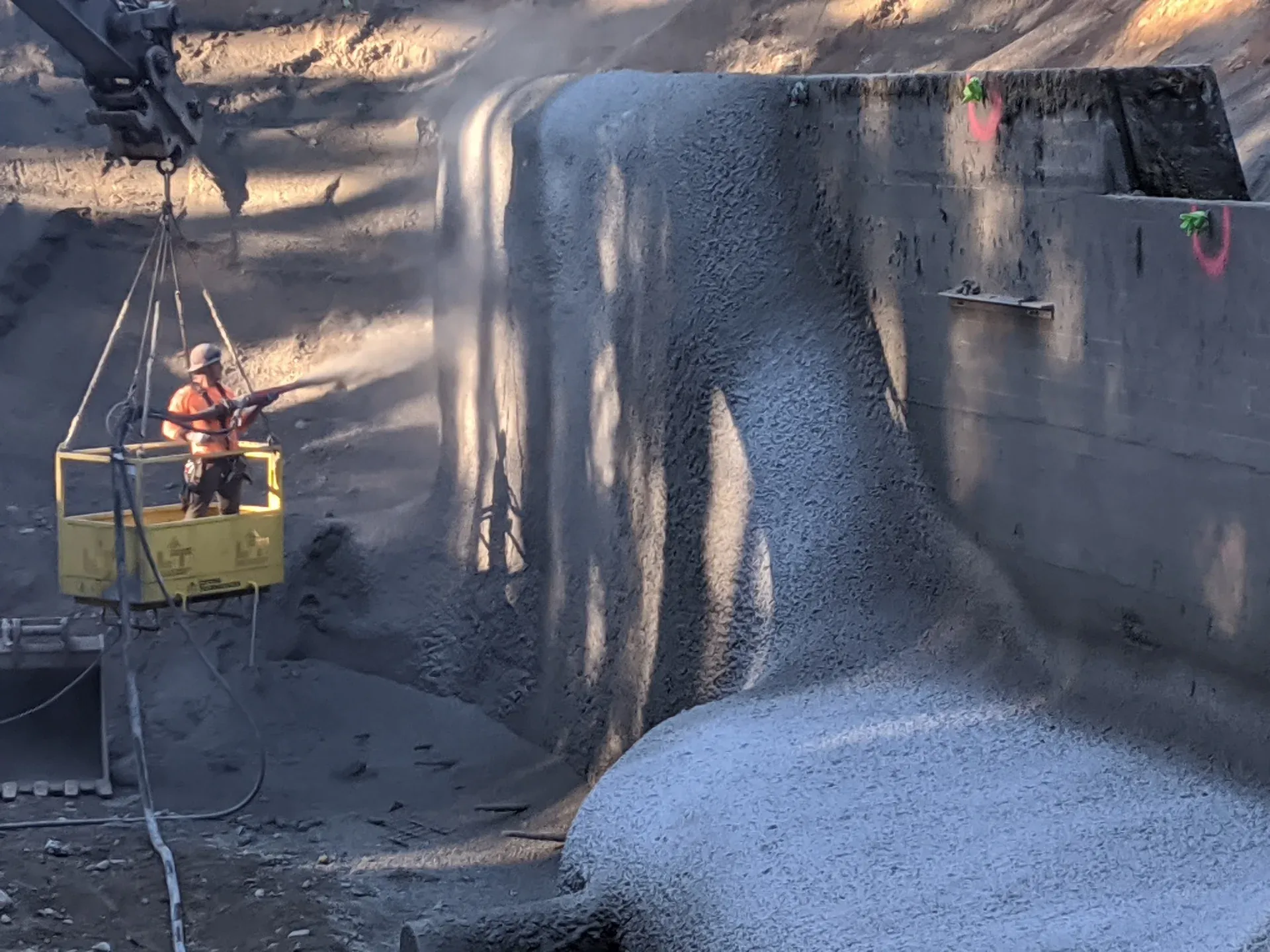
Conveying is the heart of the dry-mix process. A rotor-type or double-chamber gun feeds dry material into the airstream of a 185 to 375 cfm compressor, which propels the dry mix through a 1 to 2 inch hose to the nozzle. At the nozzle, pressurized water is injected at the manifold ring through a perforated water valve, hydrating the cement-aggregate stream in the final feet of travel. The nozzleman meters water by hand valve in real time, judging consistency from the appearance, sound, and rebound pattern of the placed material. Placement velocity at the nozzle exit is comparable to wet-mix (60 to 100 mph), but the rebound rate is higher, typically 20 to 40 percent on vertical work and 30 to 50 percent on overhead, because hydration is incomplete at the moment of impact and unbonded particles ricochet.

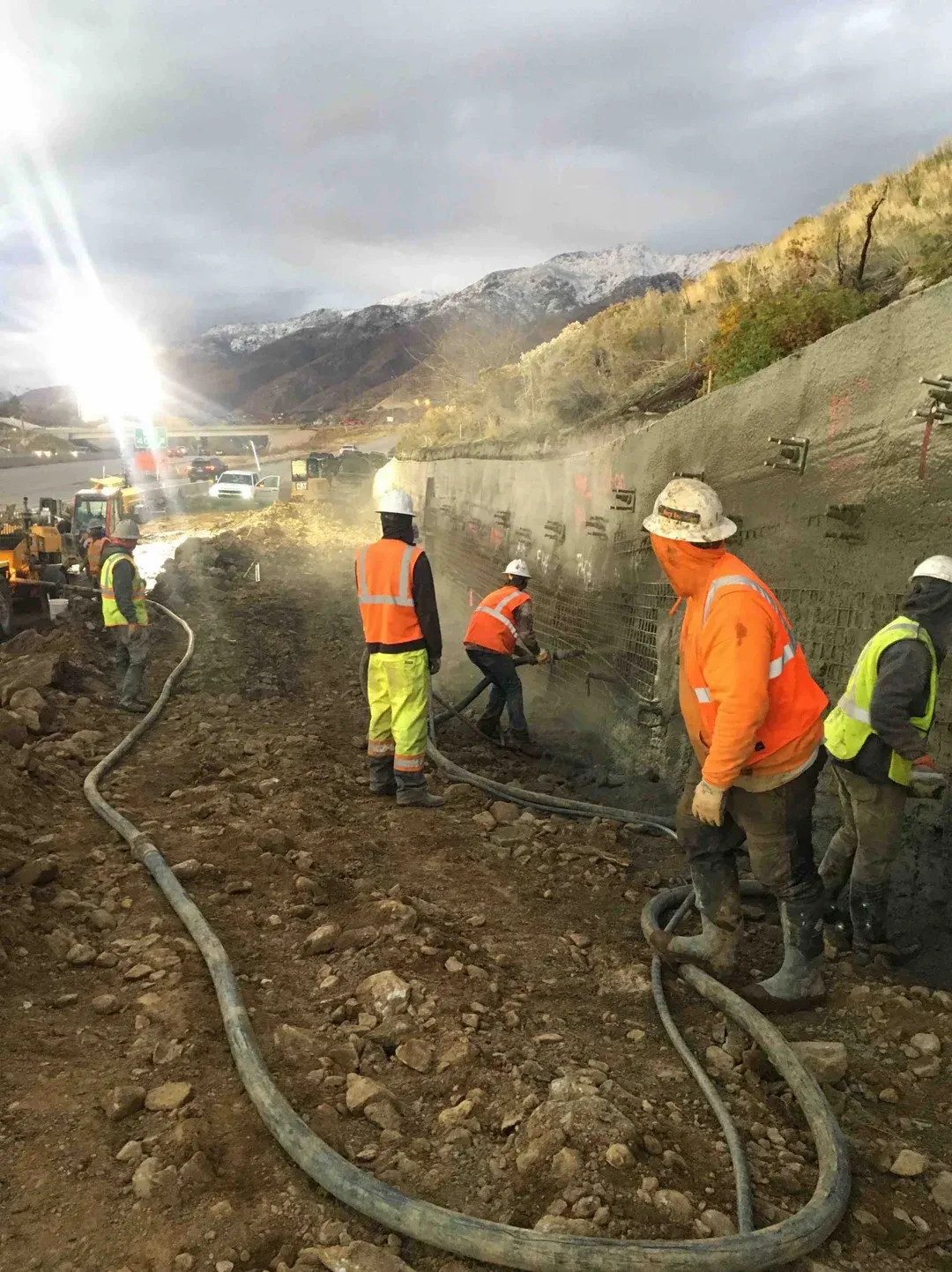
Placement discipline mirrors all structural shotcrete work. The nozzleman holds the gun approximately perpendicular to the face at a 3 to 6 foot standoff, applying material in lifts of 1 to 2 inches per pass. Reinforcement is encapsulated by gunning behind every bar from both sides before closing the face, the dominant control on shadow voids that compromise structural integrity. Successive lifts follow as the prior lift stiffens. Quality control follows ACI 506.2: production test panels (typically 18 by 18 by 4 inches) are shot alongside the work, cured under matched site conditions, and cored at 7 and 28 days for compressive strength testing per ASTM C1604, with in-place cores from the production work verifying thickness, reinforcement cover, and consolidation.

1

Material Charging

Pre-bagged dry mix or site-batched cement and aggregate loaded into the gun hopper. Mix design per ACI 506R proportioning.

2

Surface Preparation

Substrate scaled clean of loose material and dampened. Reinforcement (welded wire mesh, fibers, or rebar) placed with chairs and spacers per project structural design.

3

Conveying and Placement

Compressed air conveys dry material through delivery hose. Pressurized water injected at nozzle manifold; nozzleman meters water by valve in real time. Lifts of 1 to 2 inches per pass.

4

Encapsulation Discipline

Reinforcement gunned from both sides before closing the face. Standoff 3 to 6 feet, perpendicular nozzle angle. ACI CP-60 dry-process certified nozzleman discipline controls rebound and shadow voids.

5

Quality Control

Production test panels (18 by 18 by 4 inches) shot alongside the work and cored at 7 and 28 days. In-place ASTM C1604 cores verify thickness, cover, and compressive strength under ACI 506.2 acceptance.
System Variants

Dry-Mix Production Variants

Type 01

Pre-Bagged Dry-Mix (Gunite Tradition)

Pre-bagged dry mix delivered to the gun hopper bag-by-bag is the workhorse configuration for repair work, pool and water-feature construction, mining ground support, and small-volume civil placements. Mix proportions are fixed at the bagging plant under manufacturer's QA, with bag tolerance bounding the water-cement ratio variability that the nozzleman can introduce. Production rates of 1 to 3 cubic yards per hour and bag-by-bag stop-start logistics suit intermittent and small-area work where wet-mix mobilization (pump unit, ready-mix supply, multi-truck delivery) does not pay back. The gunite trademark from 1907 originated this configuration, and pre-bagged dry-mix remains the historical and contemporary basis of the pool, repair, and small-volume civil markets. Mix designs typically carry sand-only or 3/8 inch top-size aggregate, 4,000 to 6,000 psi 28-day compressive strength, and welded wire mesh or fiber reinforcement per project structural design.

Type 02

Site-Batched Dry-Mix

Cement, aggregate, and admixtures are proportioned and dry-mixed at the work site, charged into the gun in their dry state, and placed under the same dry-mix nozzle process. The configuration extends dry-mix to sustained-duration work where bagged supply chain or unit cost is not workable, including extended mining ground support, large-area tunnel rehabilitation, and remote slope-stabilization projects with bulk cement and aggregate delivery. Production rates approach 3 to 5 cubic yards per hour when dry batching is on the critical path. Mix proportions are controlled at the site batch rather than at the bagging plant, with QA verified by the same ACI 506.2 test-panel and coring protocol used for pre-bagged work. Site-batched dry-mix is most common where wet-mix ready-mix delivery is not available but the project duration justifies setting up bulk cement and aggregate stockpiles.

Type 03

Fiber-Reinforced Dry-Mix

Synthetic (polypropylene or polyolefin macro) or steel fibers are added to the dry mix at the bagging plant or at site batching, providing distributed crack control without the labor of installing welded wire mesh or rebar grid. The configuration suits slope-protection thin facings, tunnel-repair sections, mining ground support shotcrete, and irregular surfaces where mesh placement is impractical. Fiber dosage typically 0.3 to 1.0 percent by volume for synthetic and 0.5 to 1.5 percent for steel, calibrated through ACI 506.2 panel testing for residual flexural strength and crack control. Fiber-reinforced dry-mix is the dominant ground-support configuration in mining, where remote staging and small-area placement strongly favor dry-mix logistics over wet-mix pumping.

Side By Side

Dry-Mix vs Alternative Placement Configurations

VS

Dry-Mix vs Wet-Mix Placement

The defining difference is when water enters the mix. Dry-mix conveys dry cement and aggregate by compressed air to the nozzle, where the nozzleman meters water in by valve at placement, giving real-time water control suited to overhead, intermittent, and remote work. Wet-mix shotcrete is pre-batched at the plant or on-site mixer with full water content and pumped to the nozzle, where compressed air provides only placement velocity. Plant-batched water-cement ratio gives wet-mix consistent strength, higher production (15 to 30 plus cubic yards per hour against 1 to 3 for dry-mix), and lower rebound (10 to 20 percent on vertical work against 20 to 40 percent for dry-mix). Wet-mix dominates permanent civil structural placement; dry-mix dominates repair, remote, intermittent, and overhead-dominant work where wet-mix mobilization does not pay back.

VS

Dry-Mix Shotcrete vs Cast-in-Place Repair Mortar

Both techniques restore concrete sections, but the placement mechanism differs. Dry-mix shotcrete is consolidated by placement velocity (compressed air at the nozzle propels material at 60 to 100 mph against the substrate) and is placed without formwork, with the material conforming directly to existing concrete, rock, or soil. Cast-in-place repair mortar is hand-applied, troweled, or formed and gravity-poured, with consolidation achieved by mechanical action rather than placement velocity. Dry-mix shotcrete suits sustained-area facing, structural section restoration, and overhead repair where mortar would slump, while form-and-pour repair mortar suits spot patches, dimensionally critical edges, and surfaces accessible to a trowel finisher. Both achieve equivalent compressive strength when properly designed, but dry-mix is the only practical choice for facings, soffits, and sustained large-area rehabilitation.

VS

Pre-Bagged vs Site-Batched Dry-Mix

Pre-bagged dry mix gives the tightest QA chain, the simplest field logistics, and the lowest unit cost on small-volume and intermittent work where the bag-by-bag supply matches the placement pace. Site-batched dry-mix extends the process to sustained-duration jobs where bagged supply chain or per-bag unit cost is the bottleneck, with bulk cement and aggregate stockpiled and proportioned at the work site. Mix designs are functionally equivalent at the wall: ACI 506R proportioning applies to both, ACI 506.2 acceptance testing applies to both, and ASTM C1604 cores verify in-place strength for both. The selection is logistics and unit cost, not material performance, and a single project may use both configurations as the work pace and remaining duration shift.

Not sure which system fits? We'll walk through the tradeoffs for your site conditions.

Talk Through Your Options
Where It Fits

Where Dry-Mix Shotcrete Is Used

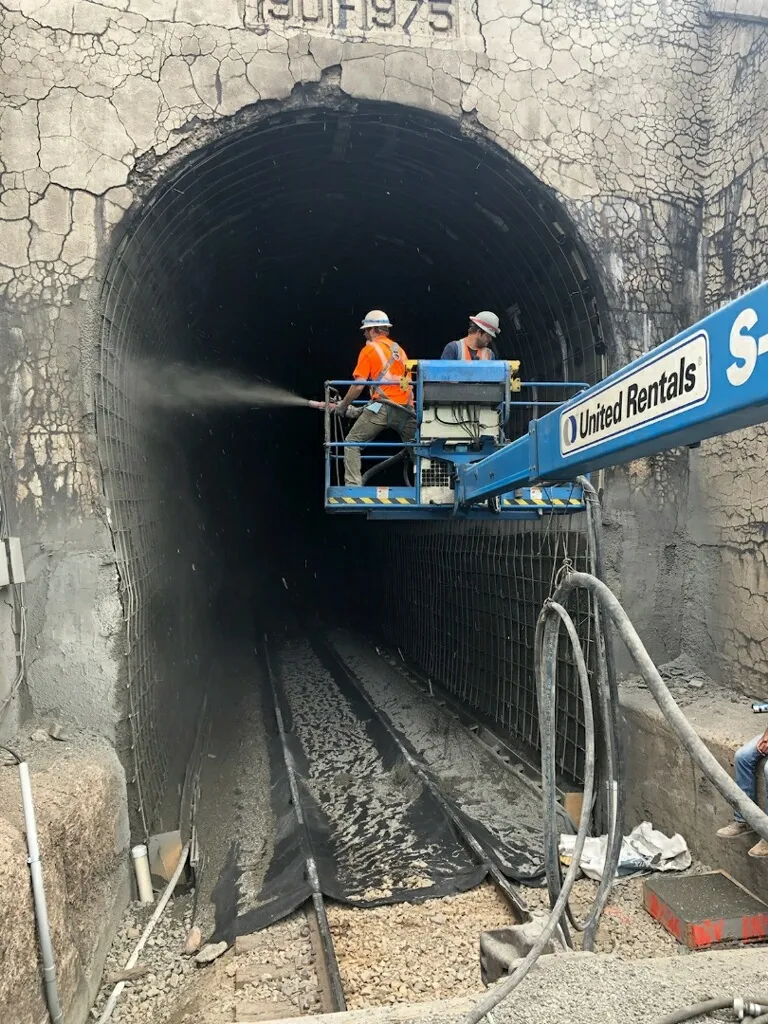
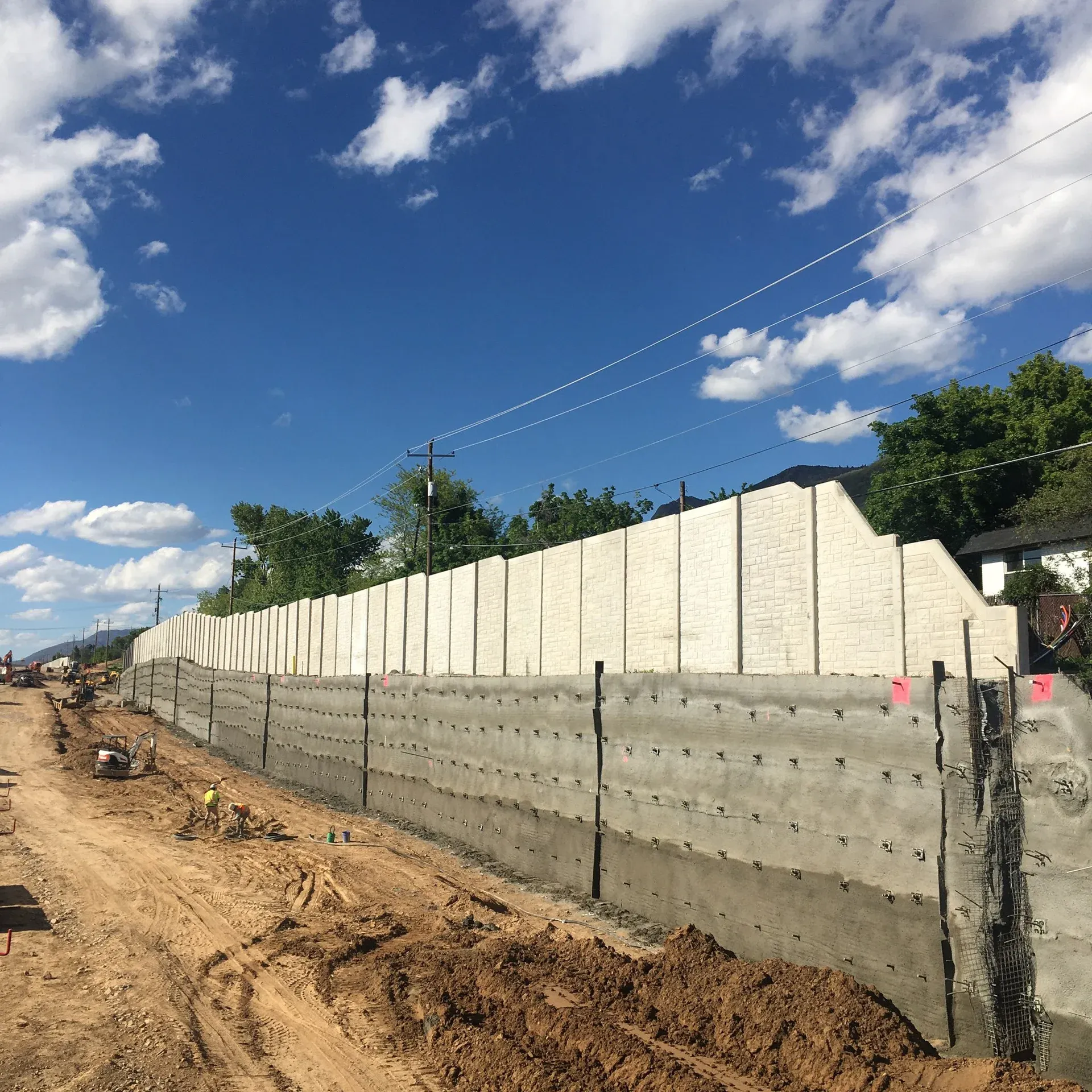
Repair and rehabilitation is the dominant dry-mix application by volume. Tunnel-lining repair (primary support and final lining patching), dam and spillway concrete restoration, culvert and channel rehabilitation, and concrete structure repair across bridges, marine, and water-handling structures all favor dry-mix because the work is intermittent, the placement areas are small, and the access (often inside enclosed structures or on irregular surfaces) defeats wet-mix pump-and-pour logistics. Overhead and tunnel-crown work is the second major application: drier nozzle consistency and operator-controlled water make dry-mix the historical preference for crown shotcrete on small-volume tunnel and bridge soffit work where wet-mix sag is limiting.

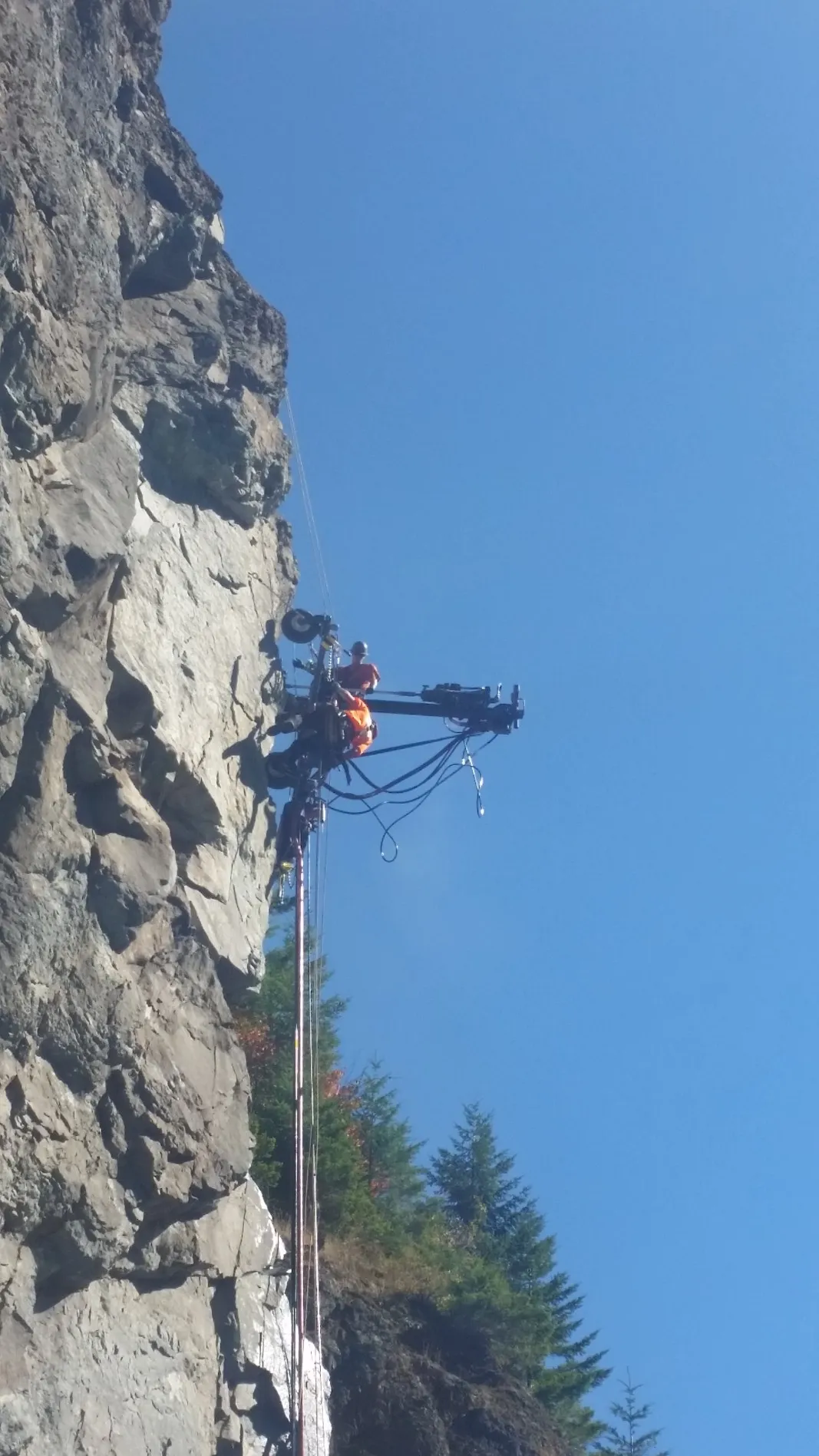
Beyond repair, dry-mix is the production process behind mining ground support (where remote staging, intermittent placement, and small-area lift requirements strongly favor dry-mix), pool and slurry-wall construction (the historical home of the gunite tradition), small-volume soil nail wall facings on remote sites, and composite rock support paired with rock bolts on small-area rock-cut faces. The portable equipment and bagged supply chain extend dry-mix into sites that would defeat ready-mix delivery: mining adits accessed by rail or trolley, dam abutments inside containment, and trail-only watershed work where helicopter sling-loads of bagged material and a single-trailer gun setup are the only practical option. Our ACI CP-60 dry-process certified shotcrete contractors produce the work under ACI 506 family specifications, with reinforcement, mix design, and acceptance testing tailored to each application.

Tunnel and culvert rehabilitation
Dam and spillway concrete repair
Mining ground support
Pool and slurry-wall construction
Remote-site slope stabilization
Overhead and tunnel-crown placement
Benefits

Key Advantages

Real-Time Water Control

The nozzleman meters water at the gun by valve, accommodating substrate variability, orientation changes, and weather without halting work. Plant-batched wet-mix has no equivalent in-place adjustment.

Portable Field Setup

A bag-fed gun, an air compressor, and pressurized water are the entire dry-mix field setup. Equipment moves on a single trailer or in helicopter sling loads, extending placement to mining adits, trail-only sites, and remote watershed work where ready-mix and pumps cannot reach.

Stop-Start Without Material Loss

Dry material in the gun hopper does not set in the line during work pauses. The configuration suits intermittent and small-area repair work that would waste batch life and pump priming for wet-mix.

Overhead and Tunnel-Crown Capability

Drier nozzle consistency and operator-controlled water make dry-mix the historical preference for tunnel crowns, bridge soffits, and overhanging rock faces where wet-mix sag and accelerator dependence are limiting.

Lower Mobilization for Small Work

Bag-fed supply, single-trailer equipment, and 1 to 3 cubic yard per hour pacing match small-volume repair, where the fixed cost of wet-mix mobilization (pump unit, ready-mix supply chain, multi-truck delivery) does not pay back.

Engineering

Technical Considerations

Soil/Rock Conditions

Substrate scaled clean of loose material and dampened before placement. Dry-mix tolerates damper substrates than wet-mix because the nozzleman can compensate at the gun valve. Bond testing required on rehabilitation work where existing surface condition is variable.

Groundwater

Drier nozzle consistency handles damp surfaces directly without sag. Significant inflow controlled by diversion or by powdered set accelerator added to the dry mix at bagging or charging.

Load Capacity

Structural capacity equivalent to wet-mix when properly applied. ACI 506R proportioning and project structural design govern; ACI 506.2 acceptance applies with ASTM C1604 cores documenting in-place strength and thickness.

Spacing

Continuous facing. Construction and expansion joints per project specifications for temperature and shrinkage control.

Installation Method

Dry materials (cement, aggregate, admixtures, fibers) conveyed by compressed air through delivery hose to nozzle. Pressurized water injected at the nozzle manifold and metered by the nozzleman in real time. Lifts 1 to 2 inches per pass.

Equipment Used

  • Dry-mix shotcrete gun (rotor-type or double-chamber)
  • Air compressor (185 to 375 cfm typical)
  • Pressurized water supply with nozzle-manifold valve
  • Pre-bagged dry mix or site-batched cement and aggregate
  • Reinforcement (welded wire mesh, fibers, or rebar)
  • Test panel forms and ASTM C1604 coring equipment

Limitations

  • Higher rebound than wet-mix (20 to 40 percent vertical, 30 to 50 percent overhead)
  • Lower production rate than wet-mix (1 to 3 against 15 to 30 cubic yards per hour)
  • Operator-dependent water-cement ratio, ACI CP-60 dry-process certification critical
  • Dust generation requires water misting, ventilation, and respiratory PPE

Technical Specifications

Compressive Strength
4,000 to 6,000+ psi
Production Rate
1 to 3 CY/hour
Rebound (Vertical)
20 to 40%
Aggregate Top Size
3/8 inch (sand-only for gunite)
Codes And References

Engineering Standards and References

ACI

ACI 506R

Guide to Shotcrete

Canonical technical reference for both wet- and dry-mix shotcrete. Covers dry-mix mix design, equipment selection, gun and hose configuration, water-valve metering, reinforcement detailing, nozzling technique, and quality-control protocols.

ACI

ACI 506.2

Specification for Shotcrete

Project specification template defining acceptance criteria, mockup requirements, test panel frequency, and qualification of nozzlemen and equipment. The dry-mix sections govern panel sampling, in-place core acceptance, and operator water-cement-ratio verification through tested cylinders.

ACI

ACI CP-60

Shotcrete Nozzleman Certification (Dry-Process)

Hands-on field certification program for shotcrete operators. The dry-mix endorsement is differentiated from wet-mix and further differentiated by orientation (vertical, overhead, horizontal) because the operator's water-valve control, gun handling, and rebound management differ materially across processes and orientations.

ASTM

ASTM C1604

Standard Test Method for Obtaining and Testing Drilled Cores of Shotcrete

The ASTM standard governing core sampling and compressive strength testing of in-place shotcrete. Acceptance testing for dry-mix structural work routinely couples production-panel cores at 7 and 28 days with in-place cores from the placed work for thickness, cover, and strength verification.

Gallery

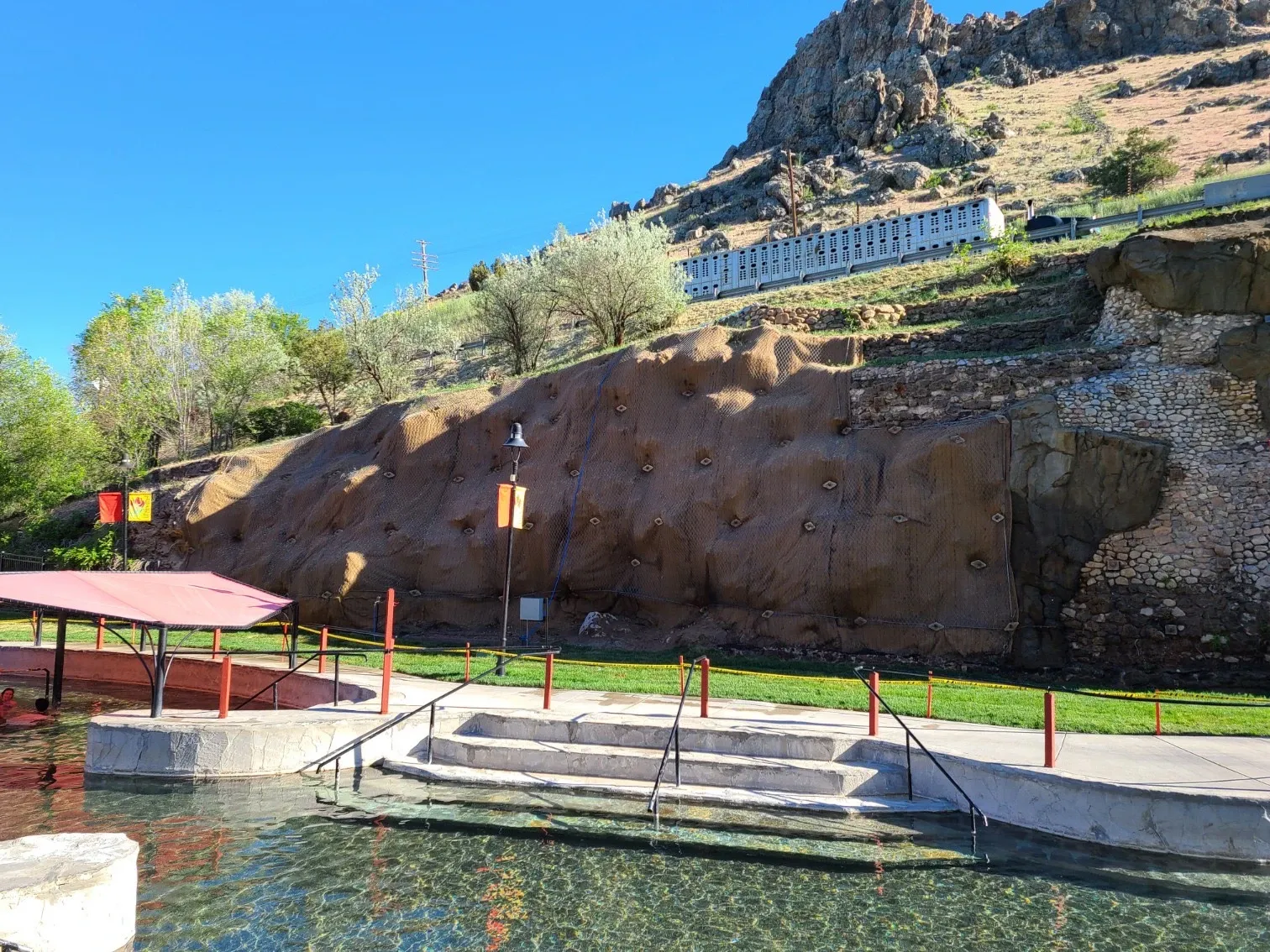
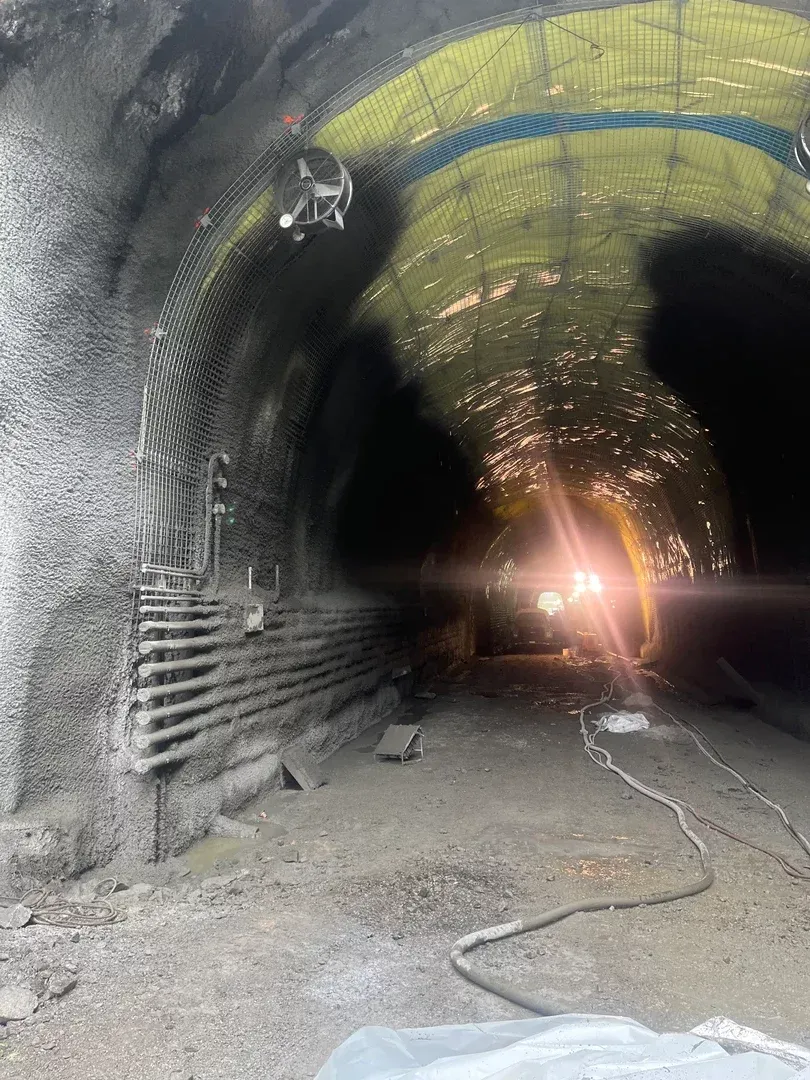
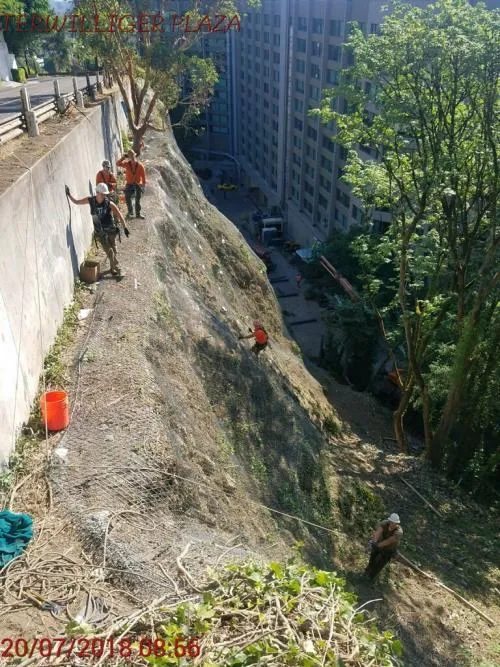
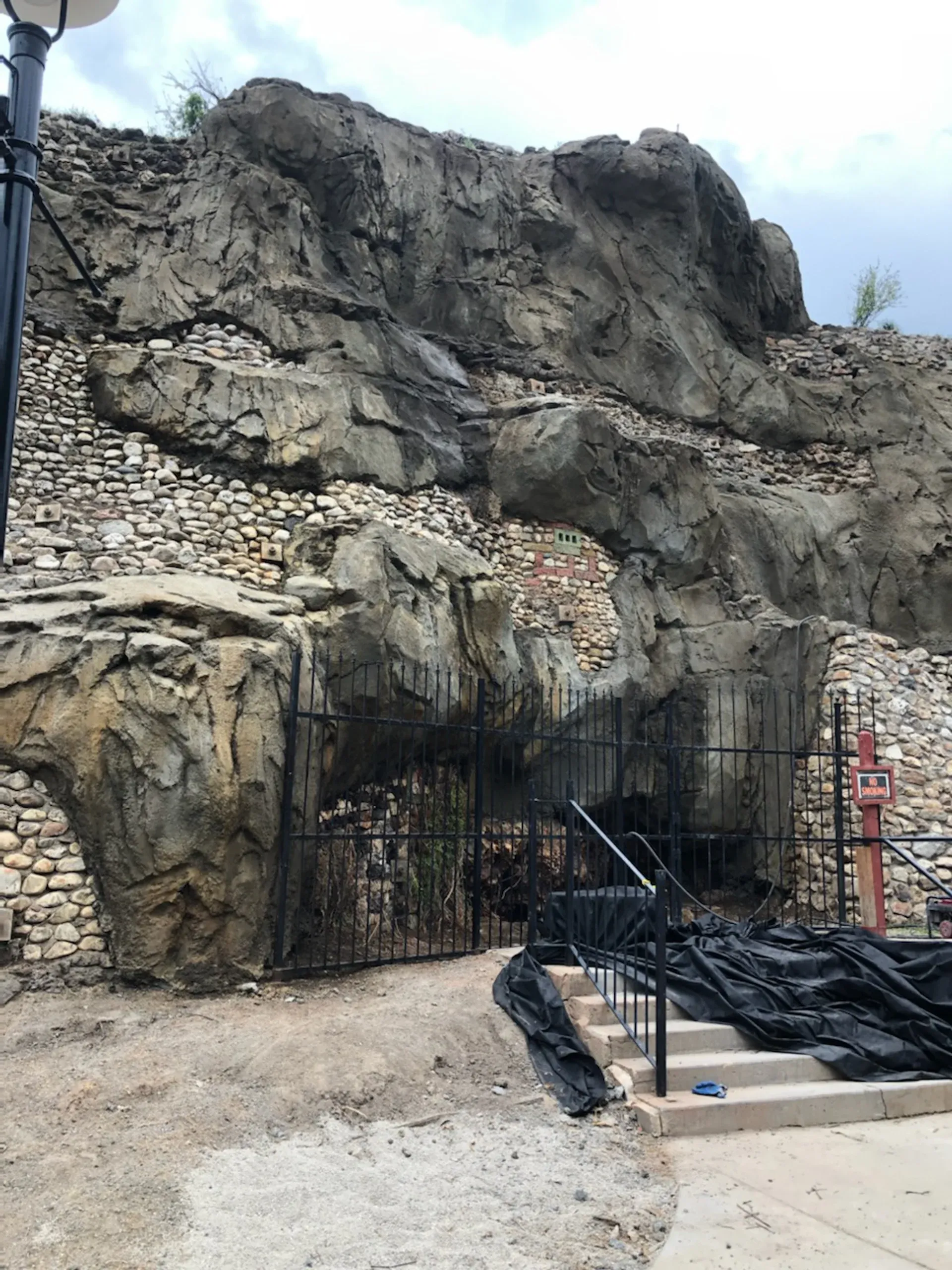
Our Work in Action

Expertise

Why Choose Rock Supremacy for Dry-Mix Shotcrete

ACI CP-60 Dry-Process Certified Nozzlemen

Dry-process certification is separate from wet-process under ACI CP-60 because gun handling, water-valve control, and rebound management differ materially. Our crews hold current dry-process endorsements across vertical, overhead, and horizontal orientations.

Self-Performed Repair-Trade Stack

Surface preparation, dowel installation, drainage detailing, and dry-mix placement are all in-house, eliminating the schedule and quality coordination gaps that arise when separate contractors handle each step on a small repair.

Remote-Site Mobilization

Remote-site mobilization capability for sites without ready-mix delivery access, including mining adits, dam abutments, and watershed work.

ACI 506.2 Quality Control on Small Work

Test panels, ASTM C1604 cores, and thickness verification follow ACI 506.2 even on intermittent and small-area placements where shortcuts on QA are common in the trade.

Questions

Shotcrete (Dry Mix) FAQ

Dry-mix shotcrete is the placement process where cement, aggregate, and admixtures are charged into the gun in their dry state, conveyed by compressed air through the delivery hose, and hydrated at the nozzle by water introduced at the manifold. ACI 506R defines this as the dry-mix process. The nozzleman meters water in real time by valve, judging consistency from the appearance of the placed material. Production typically runs 1 to 3 cubic yards per hour with vertical rebound of 20 to 40 percent. Dry-mix is the right tool for repair work, remote sites, overhead-dominant placement, and intermittent or small-volume jobs where wet-mix pump-and-pour logistics do not pay back.
The defining difference is when water enters the mix. Dry-mix conveys dry cement and aggregate by compressed air to the nozzle, where the nozzleman meters water in by valve at placement, giving real-time water control. Wet-mix is pre-batched at the plant or on-site mixer with full water content and pumped to the nozzle, where compressed air provides only placement velocity. Wet-mix gives consistent water-cement ratio, higher production (15 to 30 plus cubic yards per hour against 1 to 3 for dry-mix), and lower rebound (10 to 20 percent on vertical work against 20 to 40 percent for dry-mix). Permanent civil structural work typically uses wet-mix; repair, remote, intermittent, and overhead-dominant work typically uses dry-mix.
Gunite is the original 1907 Allentown Cement Gun Company trademark for the dry-mix shotcrete process, used predominantly on pool construction, repair work, and thin-section facings with sand-only aggregate. The trademark has long since become a generic term, and modern usage treats <em>gunite</em> as a near-synonym for dry-mix shotcrete, particularly the pre-bagged sand-aggregate configuration used in pool and water-feature work. Civil structural specifications generally use the technical term <em>dry-mix shotcrete</em> to align with ACI 506R nomenclature, but the underlying placement process is the same as the original 1907 gunite.
Hydration is incomplete at the moment of impact. Because water is metered in only at the nozzle (in the final feet of travel before the surface), the cement-aggregate stream strikes the substrate before full hydration is achieved, and unbonded particles ricochet rather than adhere. Dry-mix vertical rebound runs 20 to 40 percent against 10 to 20 percent for wet-mix, and overhead rebound is 30 to 50 percent against 20 to 30 percent. Rebound is minimized by ACI CP-60 dry-process certified nozzleman technique, proper standoff (3 to 6 feet), perpendicular gun angle, and lift discipline (1 to 2 inches per pass).
Yes, properly applied dry-mix achieves equivalent compressive strength to wet-mix shotcrete, typically 4,000 to 6,000 plus psi, verified by cores from production test panels and in-place ASTM C1604 cores at 7 and 28 days under ACI 506.2 acceptance. The key control is the nozzleman's water-valve discipline: ACI CP-60 dry-process certification is the trade qualification that bounds operator-dependent water-cement ratio variability. Where strength variability is the limiting concern, wet-mix gives a tighter QA chain through plant-batched water-cement ratio.
ACI CP-60 is the American Concrete Institute's hands-on field certification program for shotcrete operators. The dry-process endorsement is separate from the wet-process endorsement because gun handling, water-valve metering, rebound management, and lift technique differ materially between the two processes. The endorsements are further differentiated by orientation (vertical, overhead, horizontal). Permanent civil structural specifications routinely require ACI CP-60 dry-process certification for the orientation being placed, and our crews hold current endorsements across all three orientations.
Dry-mix is the right tool when at least one of these applies: the work is intermittent or small-area enough that wet-mix mobilization (pump unit, ready-mix supply chain, multi-truck delivery) does not pay back; the site is remote or access-restricted to the point that ready-mix delivery and pumping are impractical (mining adits, helicopter sling-loaded sites, dam abutments inside containment); the placement is overhead-dominant where wet-mix sag is limiting; or the substrate or schedule needs the operator's real-time water-valve adjustment. Wet-mix is the right tool for sustained-volume civil structural work with reliable truck access.
Water misting at the nozzle and around the work area is the primary control, supplemented by mechanical ventilation in enclosed work (tunnels, mining adits, indoor repair). Respiratory PPE (N95 or higher, with full-face air-supplied respirators in enclosed spaces) is required for the nozzleman and supporting crew. Pre-dampened bagged product reduces airborne dust at charging, and modern guns with rotor-seal designs minimize material loss at the gun-line interface. ACI 506.2 specifications and project safety plans address dust control as part of the dry-mix work plan.
The ACI 506 family is the primary US reference. ACI 506R is the technical guide covering dry-mix mix design, equipment, and placement; ACI 506.2 is the project specification template defining acceptance criteria, mockup requirements, test panel frequency, and operator qualification; ACI CP-60 is the field certification program for nozzlemen, with separate dry-process and wet-process endorsements. ASTM C1604 governs core sampling and compressive strength testing of placed shotcrete. For tunnel rehabilitation, FHWA NHI-10-034 sections 6 and 10 address shotcrete linings; for soil nail wall facings, FHWA NHI-14-007 governs the composite system.
Testimonials

Client Testimonials

Trusted by DOTs, engineering firms, and property owners nationwide.

Contact

Deploy Us

Ready to discuss your project? Our team is standing by to assess your site conditions and develop a custom solution using Shotcrete (Dry Mix) and other proven techniques.

Emergency (24/7)

(541) 383-7625

Bidding & Estimates

Info@RockSupremacy.com

Headquarters

Western Division (HQ)
65147 N Hwy 97
Bend, OR 97701
Eastern Division
915 Millennium Ct
Blountville, TN 37617

Licensed in CO, UT, WY, ID, MT, CA, WA, OR, TN, VA

Request Consultation